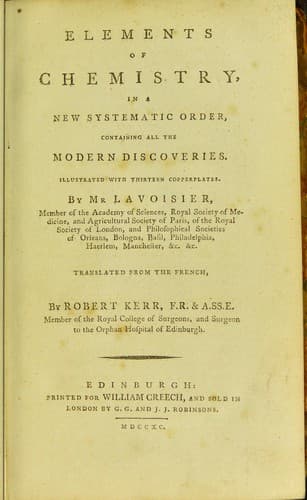
Elements of Chemistry,: In a New Systematic Order, Containing all the Modern DiscoveriesLavoisier, Antoine Laurent
Science
Elements of Chemistry,: In a New Systematic Order, Containing all the Modern Discoveries
Lavoisier, Antoine Laurent
Chemistry -- Early works to 1800
I have already shown, that 100 grs. of carbonic acid gas consists of
72 grs. of oxygen, combined with 28 grs. of charcoal; hence the 28
grs. of charcoal placed in the glass tube have acquired 72 grs. of
oxygen from the water; and it follows, that 85.7 grs. of water are
composed of 72 grs. of oxygen, combined with 13.7 grs. of a gas
susceptible of combustion. We shall see presently that this gas cannot
possibly have been disengaged from the charcoal, and must, consequently,
have been produced from the water.
I have suppressed some circumstances in the above account of this
experiment, which would only have complicated and obscured its results
in the minds of the reader. For instance, the inflammable gas dissolves
a very small part of the charcoal, by which means its weight is somewhat
augmented, and that of the carbonic gas proportionally diminished.
Altho' the alteration produced by this circumstance is very
inconsiderable; yet I have thought it necessary to determine its effects
by rigid calculation, and to report, as above, the results of the
experiment in its simplified state, as if this circumstance had not
happened. At any rate, should any doubts remain respecting the
consequences I have drawn from this experiment, they will be fully
dissipated by the following experiments, which I am going to adduce in
support of my opinion.
_Experiment Third._
The apparatus being disposed exactly as in the former experiment, with
this difference, that instead of the 28 grs. of charcoal, the tube EF
is filled with 274 grs. of soft iron in thin plates, rolled up
spirally. The tube is made red hot by means of its furnace, and the
water in the retort A is kept constantly boiling till it be all
evaporated, and has passed through the tube EF, so as to be condensed in
the bottle H.
No carbonic acid gas is disengaged in this experiment, instead of which
we obtain 416 cubical inches, or 15 grs. of inflammable gas, thirteen
times lighter than atmospheric air. By examining the water which has
been distilled, it is found to have lost 100 grs. and the 274 grs.
of iron confined in the tube are found to have acquired 85 grs.
additional weight, and its magnitude is considerably augmented. The iron
is now hardly at all attractable by the magnet; it dissolves in acids
without effervescence; and, in short, it is converted into a black oxyd,
precisely similar to that which has been burnt in oxygen gas.
In this experiment we have a true _oxydation_ of iron, by means of
water, exactly similar to that produced in air by the assistance of
heat. One hundred grains of water having been decomposed, 85 grs. of
oxygen have combined with the iron, so as to convert it into the state
of black oxyd, and 15 grs. of a peculiar inflammable gas are
disengaged: From all this it clearly follows, that water is composed of
oxygen combined with the base of an inflammable gas, in the respective
proportions of 85 parts, by weight of the former, to 15 parts of the
latter.
Public-domain text, read in full here on John Shaqi.
Reviews
Reviews
No reviews yet
Be the first to share your thoughts on this work.
Elsewhere in the archive
Join the Discussion
Join the discussion
Sign in to leave a comment or review.
Sign InorCreate an account