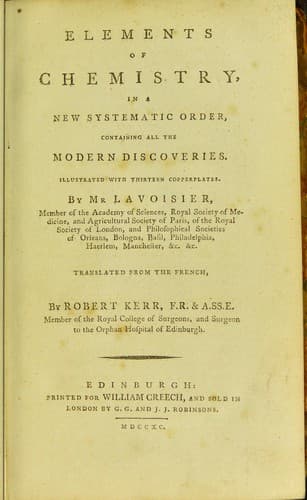
Elements of Chemistry,: In a New Systematic Order, Containing all the Modern DiscoveriesLavoisier, Antoine Laurent
Science
Elements of Chemistry,: In a New Systematic Order, Containing all the Modern Discoveries
Lavoisier, Antoine Laurent
Chemistry -- Early works to 1800
Caloric from each lib. of hydrogen gas, 295.58950.
Caloric from each lib. of oxygen gas, 52.16280.
Caloric disengaged during the formation of each pound of water, 44.33840.
Caloric retained by each lib. of oxygen after
combustion with hydrogen, 14.50386.
Caloric retained by each lib. of water at
the temperature of Zero (32 deg.), 12.32823.
_Of the Formation of Nitric Acid._
When we combine nitrous gas with oxygen gas, so as to form nitric or
nitrous acid a degree of heat is produced, which is much less
considerable than what is evolved during the other combinations of
oxygen; whence it follows that oxygen, when it becomes fixed in nitric
acid, retains a great part of the heat which it possessed in the state
of gas. It is certainly possible to determine the quantity of caloric
which is disengaged during the combination of these two gasses, and
consequently to determine what quantity remains after the combination
takes place. The first of these quantities might be ascertained, by
making the combination of the two gasses in an apparatus surrounded by
ice; but, as the quantity of caloric disengaged is very inconsiderable,
it would be necessary to operate upon a large quantity of the two gasses
in a very troublesome and complicated apparatus. By this consideration,
Mr de la Place and I have hitherto been prevented from making the
attempt. In the mean time, the place of such an experiment may be
supplied by calculations, the results of which cannot be very far from
truth.
Mr de la Place and I deflagrated a convenient quantity of nitre and
charcoal in an ice apparatus, and found that twelve pounds of ice were
melted by the deflagration of one pound of nitre. We shall see, in the
sequel, that one pound of nitre is composed, as under, of
Potash 7 oz. 6 gros 51.84 grs. = 4515.84 grs.
Dry acid 8 1 21.16 = 4700.16.
The above quantity of dry acid is composed of
Oxygen 6 oz. 3 gros 66.34 grs. = 3738.34 grs.
Azote 1 5 25.82 = 961.82.
By this we find that, during the above deflagration, 2 gros 1-1/3
gr. of charcoal have suffered combustion, alongst with 3738.34 grs.
or 6 oz. 3 gros 66.34 grs. of oxygen. Hence, since 12 libs. of
ice were melted during the combustion, it follows, that one pound of
oxygen burnt in the same manner would have melted 29.58320 libs. of
ice. To which the quantity of caloric, retained by a pound of oxygen
after combining with charcoal to form carbonic acid gas, being added,
which was already ascertained to be capable of melting 29.13844 libs.
of ice, we have for the total quantity of caloric remaining in a pound
of oxygen, when combined with nitrous gas in the nitric acid 58.72164;
which is the number of pounds of ice the caloric remaining in the oxygen
in that state is capable of melting.
Public-domain text, read in full here on John Shaqi.
Reviews
Reviews
No reviews yet
Be the first to share your thoughts on this work.
Elsewhere in the archive
Join the Discussion
Join the discussion
Sign in to leave a comment or review.
Sign InorCreate an account