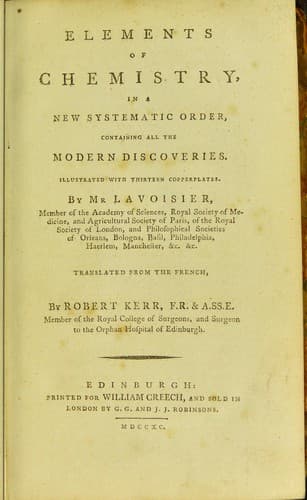
Elements of Chemistry,: In a New Systematic Order, Containing all the Modern DiscoveriesLavoisier, Antoine Laurent
Science
Elements of Chemistry,: In a New Systematic Order, Containing all the Modern Discoveries
Lavoisier, Antoine Laurent
Chemistry -- Early works to 1800
We have before seen that, in the state of oxygen gas, it contained at
least 66.66667; wherefore it follows that, in combining with azote to
form nitric acid, it only loses 7.94502. Farther experiments upon this
subject are necessary to ascertain how far the results of this
calculation may agree with direct fact. This enormous quantity of
caloric retained by oxygen in its combination into nitric acid, explains
the cause of the great disengagement of caloric during the
deflagrations of nitre; or, more strictly speaking, upon all occasions
of the decomposition of nitric acid.
_Of the Combustion of Wax._
Having examined several cases of simple combustion, I mean now to give a
few examples of a more complex nature. One pound of wax-taper being
allowed to burn slowly in an ice apparatus, melted 133 libs. 2 oz.
5-1/3 gros of ice. According to my experiments in the Memoirs of the
Academy for 1784, p. 606, one pound of wax-taper consists of 13 oz. 1
gros 23 grs. of charcoal, and 2 oz. 6 gros 49 grs. of
hydrogen.
By the foregoing experiments, the above
quantity of charcoal ought to melt 79.39390 libs. of ice;
and the hydrogen should melt 52.37605
---------
In all 131.76995 libs.
Thus, we see the quantity of caloric disengaged from a burning taper, is
pretty exactly conformable to what was obtained by burning separately a
quantity of charcoal and hydrogen equal to what enters into its
composition. These experiments with the taper were several times
repeated, so that I have reason to believe them accurate.
_Combustion of Olive Oil._
We included a burning lamp, containing a determinate quantity of
olive-oil, in the ordinary apparatus, and, when the experiment was
finished, we ascertained exactly the quantities of oil consumed, and of
ice melted; the result was, that, during the combustion of one pound of
olive-oil, 148 libs. 14 oz. 1 gros of ice were melted. By my
experiments in the Memoirs of the Academy for 1784, and of which the
following Chapter contains an abstract, it appears that one pound of
olive-oil consists of 12 oz. 5 gros 5 grs. of charcoal, and 3
oz. 2 gros 67 grs. of hydrogen. By the foregoing experiments, that
quantity of charcoal should melt 76.18723 libs. of ice, and the
quantity of hydrogen in a pound of the oil should melt 62.15053 libs.
The sum of these two gives 138.33776 libs. of ice, which the two
constituent elements of the oil would have melted, had they separately
suffered combustion, whereas the oil really melted 148.88330 libs.
which gives an excess of 10.54554 in the result of the experiment above
the calculated result, from data furnished by former experiments.
Public-domain text, read in full here on John Shaqi.
Reviews
Reviews
No reviews yet
Be the first to share your thoughts on this work.
Elsewhere in the archive
Join the Discussion
Join the discussion
Sign in to leave a comment or review.
Sign InorCreate an account