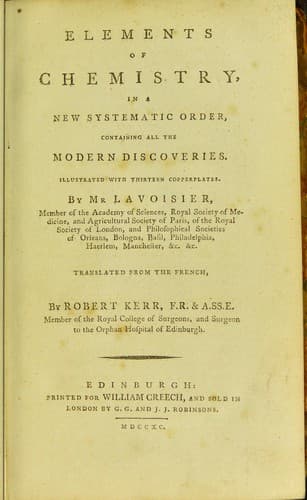
Elements of Chemistry,: In a New Systematic Order, Containing all the Modern DiscoveriesLavoisier, Antoine Laurent
Science
Elements of Chemistry,: In a New Systematic Order, Containing all the Modern Discoveries
Lavoisier, Antoine Laurent
Chemistry -- Early works to 1800
As combustible substances in general have a great affinity for oxygen,
they ought likewise to attract, or tend to combine with each other;
_quae sunt eadem uni tertio, sunt eadem inter se_; and the axiom is
found to be true. Almost all the metals, for instance, are capable of
uniting with each other, and forming what are called _alloys_[22], in
common language. Most of these, like all combinations, are susceptible
of several degrees of saturation; the greater number of these alloys are
more brittle than the pure metals of which they are composed, especially
when the metals alloyed together are considerably different in their
degrees of fusibility. To this difference in fusibility, part of the
phenomena attendant upon _alloyage_ are owing, particularly the property
of iron, called by workmen _hotshort_. This kind of iron must be
considered as an alloy, or mixture of pure iron, which is almost
infusible, with a small portion of some other metal which fuses in a
much lower degree of heat. So long as this alloy remains cold, and both
metals are in the solid state, the mixture is malleable; but, if heated
to a sufficient degree to liquify the more fusible metal, the particles
of the liquid metal, which are interposed between the particles of the
metal remaining solid, must destroy their continuity, and occasion the
alloy to become brittle. The alloys of mercury, with the other metals,
have usually been called _amalgams_, and we see no inconvenience from
continuing the use of that term.
Sulphur, phosphorus, and charcoal, readily unite with metals.
Combinations of sulphur with metals are usually named _pyrites_. Their
combinations with phosphorus and charcoal are either not yet named, or
have received new names only of late; so that we have not scrupled to
change them according to our principles. The combinations of metal and
sulphur we call _sulphurets_, those with phosphorus _phosphurets_, and
those formed with charcoal _carburets_. These denominations are extended
to all the combinations into which the above three substances enter,
without being previously oxygenated. Thus, the combination of sulphur
with potash, or fixed vegetable alkali, is called _sulphuret of potash_;
that which it forms with ammoniac, or volatile alkali, is termed
_sulphuret of ammoniac_.
Public-domain text, read in full here on John Shaqi.
Reviews
Reviews
No reviews yet
Be the first to share your thoughts on this work.
Elsewhere in the archive
Join the Discussion
Join the discussion
Sign in to leave a comment or review.
Sign InorCreate an account