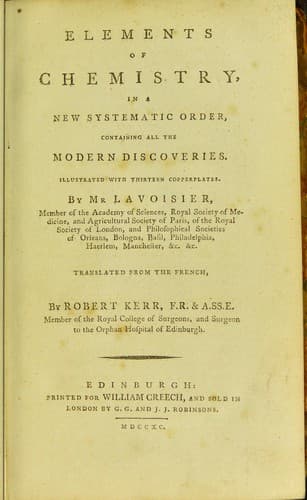
Elements of Chemistry,: In a New Systematic Order, Containing all the Modern DiscoveriesLavoisier, Antoine Laurent
Science
Elements of Chemistry,: In a New Systematic Order, Containing all the Modern Discoveries
Lavoisier, Antoine Laurent
Chemistry -- Early works to 1800
Hydrogen is likewise capable of combining with many combustible
substances. In the state of gas, it dissolves charcoal, sulphur,
phosphorus, and several metals; we distinguish these combinations by the
terms, _carbonated hydrogen gas_, _sulphurated hydrogen gas_, and
_phosphorated hydrogen gas_. The sulphurated hydrogen gas was called
_hepatic air_ by former chemists, or _foetid air from sulphur_, by Mr
Scheele. The virtues of several mineral waters, and the foetid smell of
animal excrements, chiefly arise from the presence of this gas. The
phosphorated hydrogen gas is remarkable for the property, discovered by
Mr Gengembre, of taking fire spontaneously upon getting into contact
with atmospheric air, or, what is better, with oxygen gas. This gas has
a strong flavour, resembling that of putrid fish; and it is very
probable that the phosphorescent quality of fish, in the state of
putrefaction, arises from the escape of this species of gas. When
hydrogen and charcoal are combined together, without the intervention of
caloric, to bring the hydrogen into the state of gas, they form oil,
which is either fixed or volatile, according to the proportions of
hydrogen and charcoal in its composition. The chief difference between
fixed or fat oils drawn from vegetables by expression, and volatile or
essential oils, is, that the former contains an excess of charcoal,
which is separated when the oils are heated above the degree of boiling
water; whereas the volatile oils, containing a just proportion of these
two constituent ingredients, are not liable to be decomposed by that
heat, but, uniting with caloric into the gasseous state, pass over in
distillation unchanged.
In the Memoirs of the Academy for 1784, p. 593. I gave an account of my
experiments upon the composition of oil and alkohol, by the union of
hydrogen with charcoal, and of their combination with oxygen. By these
experiments, it appears that fixed oils combine with oxygen during
combustion, and are thereby converted into water and carbonic acid. By
means of calculation applied to the products of these experiments, we
find that fixed oil is composed of 21 parts, by weight, of hydrogen
combined with 79 parts of charcoal. Perhaps the solid substances of an
oily nature, such as wax, contain a proportion of oxygen, to which they
owe their state of solidity. I am at present engaged in a series of
experiments, which I hope will throw great light upon this subject.
Public-domain text, read in full here on John Shaqi.
Reviews
Reviews
No reviews yet
Be the first to share your thoughts on this work.
Elsewhere in the archive
Join the Discussion
Join the discussion
Sign in to leave a comment or review.
Sign InorCreate an account