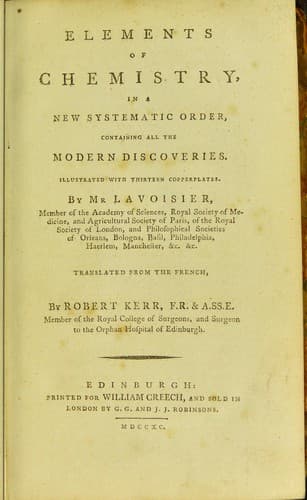
Elements of Chemistry,: In a New Systematic Order, Containing all the Modern DiscoveriesLavoisier, Antoine Laurent
Science
Elements of Chemistry,: In a New Systematic Order, Containing all the Modern Discoveries
Lavoisier, Antoine Laurent
Chemistry -- Early works to 1800
Such is the result of putrefaction when the substances submitted to it
contain only oxygen, hydrogen, charcoal and a little earth. But this
case is rare, and these substances putrify imperfectly and with
difficulty, and require a considerable time to complete their
putrefaction. It is otherwise with substances containing azote, which
indeed exists in all animal matters, and even in a considerable number
of vegetable substances. This additional element is remarkably
favourable to putrefaction; and for this reason animal matter is mixed
with vegetable, when the putrefaction of these is wished to be hastened.
The whole art of forming composts and dunghills, for the purposes of
agriculture, consists in the proper application of this admixture.
The addition of azote to the materials of putrefaction not only
accelerates the process, that element likewise combines with part of
the hydrogen, and forms a new substance called _volatile alkali_ or
_ammoniac_. The results obtained by analysing animal matters, by
different processes, leave no room for doubt with regard to the
constituent elements of ammoniac; whenever the azote has been previously
separated from these substances, no ammoniac is produced; and in all
cases they furnish ammoniac only in proportion to the azote they
contain. This composition of ammoniac is likewise fully proved by Mr
Berthollet, in the Memoirs of the Academy for 1785, p. 316. where he
gives a variety of analytical processes by which ammoniac is decomposed,
and its two elements, azote and hydrogen, procured separately.
I already mentioned in Chap. X. that almost all combustible bodies were
capable of combining with each other; hydrogen gas possesses this
quality in an eminent degree, it dissolves charcoal, sulphur, and
phosphorus, producing the compounds named _carbonated hydrogen gas_,
_sulphurated hydrogen gas_, and _phosphorated hydrogen gas_. The two
latter of these gasses have a peculiarly disagreeable flavour; the
sulphurated hydrogen gas has a strong resemblance to the smell of rotten
eggs, and the phosphorated smells exactly like putrid fish. Ammoniac has
likewise a peculiar odour, not less penetrating, or less disagreeable,
than these other gasses. From the mixture of these different flavours
proceeds the fetor which accompanies the putrefaction of animal
substances. Sometimes ammoniac predominates, which is easily perceived
by its sharpness upon the eyes; sometimes, as in feculent matters, the
sulphurated gas is most prevalent; and sometimes, as in putrid herrings,
the phosphorated hydrogen gas is most abundant.
Public-domain text, read in full here on John Shaqi.
Reviews
Reviews
No reviews yet
Be the first to share your thoughts on this work.
Elsewhere in the archive
Join the Discussion
Join the discussion
Sign in to leave a comment or review.
Sign InorCreate an account