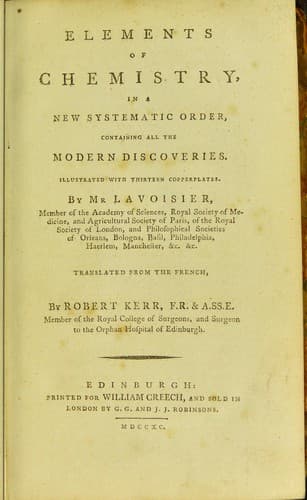
Elements of Chemistry,: In a New Systematic Order, Containing all the Modern DiscoveriesLavoisier, Antoine Laurent
Science
Elements of Chemistry,: In a New Systematic Order, Containing all the Modern Discoveries
Lavoisier, Antoine Laurent
Chemistry -- Early works to 1800
The potash obtained by this process is always less or more saturated
with carbonic acid, which is easily accounted for: As the potash does
not form, or at least is not set free, but in proportion as the
charcoal of the vegetable is converted into carbonic acid by the
addition of oxygen, either from the air or the water, it follows, that
each particle of potash, at the instant of its formation, or at least of
its liberation, is in contact with a particle of carbonic acid, and, as
there is a considerable affinity between these two substances, they
naturally combine together. Although the carbonic acid has less affinity
with potash than any other acid, yet it is difficult to separate the
last portions from it. The most usual method of accomplishing this is to
dissolve the potash in water; to this solution add two or three times
its weight of quick-lime, then filtrate the liquor and evaporate it in
close vessels; the saline substance left by the evaporation is potash
almost entirely deprived of carbonic acid. In this state it is soluble
in an equal weight of water, and even attracts the moisture of the air
with great avidity; by this property it furnishes us with an excellent
means of rendering air or gas dry by exposing them to its action. In
this state it is soluble in alkohol, though not when combined with
carbonic acid; and Mr Berthollet employs this property as a method of
procuring potash in the state of perfect purity.
All vegetables yield less or more of potash in consequence of
combustion, but it is furnished in various degrees of purity by
different vegetables; usually, indeed, from all of them it is mixed
with different salts from which it is easily separable. We can hardly
entertain a doubt that the ashes, or earth which is left by vegetables
in combustion, pre-existed in them before they were burnt, forming what
may be called the skeleton, or osseous part of the vegetable. But it is
quite otherwise with potash; this substance has never yet been procured
from vegetables but by means of processes or intermedia capable of
furnishing oxygen and azote, such as combustion, or by means of nitric
acid; so that it is not yet demonstrated that potash may not be a
produce from these operations. I have begun a series of experiments upon
this object, and hope soon to be able to give an account of their
results.
Sec. 2. _Of Soda._
Public-domain text, read in full here on John Shaqi.
Reviews
Reviews
No reviews yet
Be the first to share your thoughts on this work.
Elsewhere in the archive
Join the Discussion
Join the discussion
Sign in to leave a comment or review.
Sign InorCreate an account