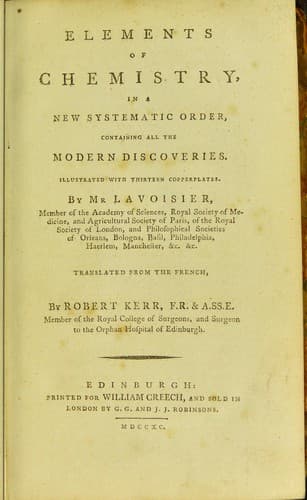
Elements of Chemistry,: In a New Systematic Order, Containing all the Modern DiscoveriesLavoisier, Antoine Laurent
Science
Elements of Chemistry,: In a New Systematic Order, Containing all the Modern Discoveries
Lavoisier, Antoine Laurent
Chemistry -- Early works to 1800
Soda, like potash, is an alkali procured by lixiviation from the ashes
of burnt plants, but only from those which grow upon the sea-side, and
especially from the herb _kali_, whence is derived the name _alkali_,
given to this substance by the Arabians. It has some properties in
common with potash, and others which are entirely different: In general,
these two substances have peculiar characters in their saline
combinations which are proper to each, and consequently distinguish them
from each other; thus soda, which, as obtained from marine plants, is
usually entirely saturated with carbonic acid, does not attract the
humidity of the atmosphere like potash, but, on the contrary,
desiccates, its cristals effloresce, and are converted into a white
powder having all the properties of soda, which it really is, having
only lost its water of cristallization.
Hitherto we are not better acquainted with the constituent elements of
soda than with those of potash, being equally uncertain whether it
previously existed ready formed in the vegetable or is a combination of
elements effected by combustion. Analogy leads us to suspect that azote
is a constituent element of all the alkalies, as is the case with
ammoniac; but we have only slight presumptions, unconfirmed by any
decisive experiments, respecting the composition of potash and soda.
Sec. 3. _Of Ammoniac._
We have, however, very accurate knowledge of the composition of
ammoniac, or volatile alkali, as it is called by the old chemists. Mr
Berthollet, in the Memoirs of the Academy for 1784, p. 316. has proved
by analysis, that 1000 parts of this substance consist of about 807
parts of azote combined with 193 parts of hydrogen.
Ammoniac is chiefly procurable from animal substances by distillation,
during which process the azote and hydrogen necessary to its formation
unite in proper proportions; it is not, however, procured pure by this
process, being mixed with oil and water, and mostly saturated with
carbonic acid. To separate these substances it is first combined with an
acid, the muriatic for instance, and then disengaged from that
combination by the addition of lime or potash. When ammoniac is thus
produced in its greatest degree of purity it can only exist under the
gasseous form, at least in the usual temperature of the atmosphere, it
has an excessively penetrating smell, is absorbed in large quantities by
water, especially if cold and assisted by compression. Water thus
saturated with ammoniac has usually been termed volatile alkaline fluor;
we shall call it either simply ammoniac, or liquid ammoniac, and
ammoniacal gas when it exists in the aeriform state.
Sec. 4. _Of Lime, Magnesia, Barytes, and Argill._
Public-domain text, read in full here on John Shaqi.
Reviews
Reviews
No reviews yet
Be the first to share your thoughts on this work.
Elsewhere in the archive
Join the Discussion
Join the discussion
Sign in to leave a comment or review.
Sign InorCreate an account