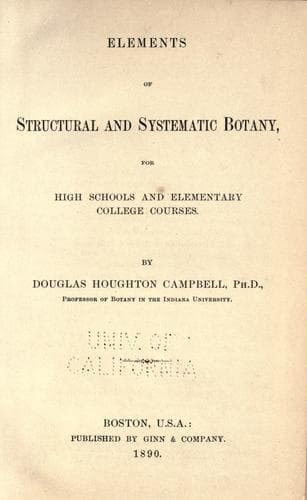
Elements of Structural and Systematic Botany: For High Schools and Elementary College CoursesCampbell, Douglas Houghton
Science
Elements of Structural and Systematic Botany: For High Schools and Elementary College Courses
Campbell, Douglas Houghton
Botany -- Textbooks
There are three orders of the _Iulifloræ_: _Amentaceæ_, _Piperineæ_,
and _Urticinæ_. The first contains the birches (_Betulaceæ_); oaks,
beeches, hazels, etc. (_Cupuliferæ_); walnuts and hickories
(_Juglandeæ_); willows and poplars (_Salicaceæ_). They are all trees
or shrubs; the fruit is often a nut, and the embryo is very large,
completely filling it.
The _Piperineæ_ are mostly tropical plants, and include the pepper
plant (_Piper_), as well as other plants with similar properties. Of
our native forms, the only common one is the lizard-tail (_Saururus_),
not uncommon in swampy ground. In these plants, the calyx and corolla
are entirely absent, but the flowers have both carpels and stamens
(Fig. 97, _H_).
The _Urticinæ_ include, among our common plants, the nettle family
(_Urticaceæ_); plane family (_Plataneæ_), represented by the sycamore
or buttonwood (_Platanus_); the hemp family (_Cannabineæ_); and the
elm family (_Ulmaceæ_). The flowers usually have a calyx, and may
have only stamens or carpels, or both. Sometimes the part of the stem
bearing the flowers may become enlarged and juicy, forming a
fruit-like structure. Well-known examples of this are the fig and
mulberry.
The second group of the _Choripetalæ_ is called _Centrospermæ_, and
includes but a single order comprising seven families, all of which,
except one (_Nyctagineæ_), are represented by numerous native species.
The latter comprises mostly tropical plants, and is represented in our
gardens by the showy "four-o'clock" (_Mirabilis_). In this plant, as
in most of the order, the corolla is absent, but here the calyx is
large and brightly colored, resembling closely the corolla of a
morning-glory or petunia. The stamens are usually more numerous than
the sepals, and the pistil, though composed of several carpels, has,
as a rule, but a single cavity with the ovules arising from the base,
though sometimes the ovary is several celled.
[Illustration: FIG. 98.--Types of _Centrospermæ_. _A_, plant of
spring-beauty, _Claytonia_ (_Portulacaceæ_), × ½. _B_, a single
flower, × 1. _C_, fruit, with the sepals removed, × 2. _D_, section of
the seed, showing the curved embryo (_em._), × 5. _E_, single flower
of smart-weed, _Polygonum_ (_Polygonaceæ_), × 2. _F_, the pistil, × 2.
_G_, section of the ovary, showing the single ovule, × 4. _H_, section
of the seed, × 2. _I_, base of the leaf, showing the sheath, × 1. _J_,
flower of pig-weed, _Chenopodium_ (_Chenopodiaceæ_), × 3: i, from
without; ii, in section. _K_, flower of the poke-weed, _Phytolacca_
(_Phytolaccaceæ_), × 2. _L_, fire-pink, _Silene_ (_Caryophyllaceæ_),
× ½. _M_, a flower with half of the calyx and corolla removed, × 1.
_N_, ripe fruit of mouse-ear chick-weed, _Cerastium_ (_Caryophyllaceæ_),
opening by ten teeth at the summit, × 2. _O_, diagram of the flower
of _Silene_.]
Public-domain text, read in full here on John Shaqi.
Reviews
Reviews
No reviews yet
Be the first to share your thoughts on this work.
Elsewhere in the archive
Join the Discussion
Join the discussion
Sign in to leave a comment or review.
Sign InorCreate an account