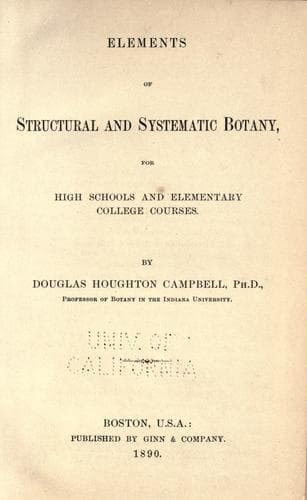
Elements of Structural and Systematic Botany: For High Schools and Elementary College CoursesCampbell, Douglas Houghton
Science
Elements of Structural and Systematic Botany: For High Schools and Elementary College Courses
Campbell, Douglas Houghton
Botany -- Textbooks
The first family (_Polygoneæ_) is represented by the various species
of _Polygonum_ (knotgrass, smart-weed, etc.), and among cultivated
plants by the buckwheat (_Fagopyrum_). The goose-foot or pig-weed
(_Chenopodium_) among native plants, and the beet and spinach of the
gardens are examples of the family _Chenopodiaceæ_. Nearly resembling
the last is the amaranth family (_Amarantaceæ_), of which the showy
amaranths and coxcombs of the gardens, and the coarse, green amaranth
or pig-weed are representatives.
The poke-weed (_Phytolacca_) (Fig. 98, _K_), so conspicuous in autumn
on account of its dark-purple clusters of berries and crimson stalks,
is our only representative of the family _Phytolaccaceæ_. The two
highest families are the purslane family (_Portulacaceæ_) and pink
family (_Caryophylleæ_). These are mostly plants with showy flowers in
which the petals are large and conspicuous, though some of the pink
family, _e.g._ some chick-weeds, have no petals. Of the purslane
family the portulacas of the gardens, and the common purslane or
"pusley," and the spring-beauty (_Claytonia_) (Fig. 98, _A_) are the
commonest examples. The pink family is represented by many common and
often showy plants. The carnation, Japanese pinks, and sweet-william,
all belonging to the genus _Dianthus_, of which there are also two or
three native species, are among the showiest of the family. The genera
_Lychnis_ and _Silene_ (Fig. 98, _L_) also contain very showy species.
Of the less conspicuous genera, the chick-weeds (_Cerastium_ and
_Stellaria_) are the most familiar.
The third group of the _Choripetalæ_ (the _Aphanocyclæ_) is a very
large one and includes many common plants distributed among five
orders. The lower ones have all the parts of the flower entirely
separate, and often indefinite in number; the higher have the gynœcium
composed of two or more carpels united to form a compound pistil.
The first order (_Polycarpæ_) includes ten families, of which the
buttercup family (_Ranunculaceæ_) is the most familiar. The plants of
this family show much variation in the details of the flowers, which
are usually showy, but the general plan is much the same. In some of
them, like the anemones (Fig. 99, _A_), clematis, and others, the
corolla is absent, but the sepals are large and brightly colored so as
to appear like petals. In the columbine (_Aquilegia_) (Fig. 99, _F_)
the petals are tubular, forming nectaries, and in the larkspur
(Fig. 99, _T_) one of the sepals is similarly changed.
Representing the custard-apple family (_Anonaceæ_) is the curious
papaw (_Asimina_), common in many parts of the United States
(Fig. 100, _A_). The family is mainly a tropical one, but this species
extends as far north as southern Michigan.
Public-domain text, read in full here on John Shaqi.
Reviews
Reviews
No reviews yet
Be the first to share your thoughts on this work.
Elsewhere in the archive
Join the Discussion
Join the discussion
Sign in to leave a comment or review.
Sign InorCreate an account