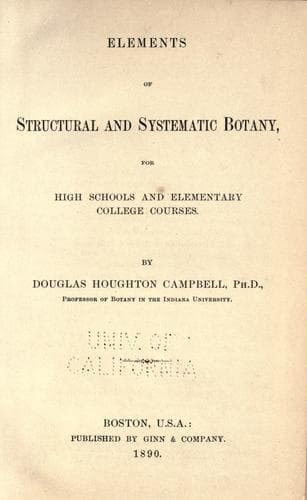
Elements of Structural and Systematic Botany: For High Schools and Elementary College CoursesCampbell, Douglas Houghton
Science
Elements of Structural and Systematic Botany: For High Schools and Elementary College Courses
Campbell, Douglas Houghton
Botany -- Textbooks
There are three families, all represented within the United States.
The first (_Nelumbieæ_) has but a single species, the yellow lotus or
nelumbo (_Nelumbo lutea_), common in the waters of the west and
southwest, but rare eastward (Fig. 101, _F_). In this flower, the end
of the flower axis is much enlarged, looking like the rose of a
watering-pot, and has the large, separate carpels embedded in its
upper surface. When ripe, each forms a nut-like fruit which is edible.
There are but two species of _Nelumbo_ known, the second one
(_N. speciosa_) being a native of southeastern Asia, and probably
found in ancient times in Egypt, as it is represented frequently in
the pictures and carvings of the ancient Egyptians. It differs mainly
from our species in the color of its flowers which are red instead of
yellow. It has recently been introduced into New Jersey where it has
become well established in several localities.
The second family (_Cabombeæ_) is also represented at the north by but
one species, the water shield (_Brasenia_), not uncommon in marshes.
Its flowers are quite small, of a dull-purple color, and the leaves
oval in outline and centrally peltate, _i.e._ the leaf stalk inserted
in the centre. The whole plant is covered with a transparent
gelatinous coat.
The third family (_Nymphæaceæ_) includes the common white water-lilies
(_Castalia_) and the yellow water-lilies (_Nymphæa_) (Fig. 102, _A_).
In the latter the petals are small and inconspicuous (Fig. 102, _C_,
_p_), but the sepals are large and showy. In this family the carpels,
instead of being separate, are united into a large compound pistil.
The water-lilies reach their greatest perfection in the tropics, where
they attain an enormous size, the white, blue, or red flowers of some
species being thirty centimetres or more in diameter, and the leaves
of the great _Victoria regia_ of the Amazon reaching two metres or
more in width.
The third order of the _Aphanocyclæ_ (_Rhœadinæ_ or _Crucifloræ_)
comprises a number of common plants, principally characterized by
having the parts of the flowers in twos or fours, so that they are
more or less distinctly cross-shaped, whence the name _Crucifloræ_.
There are four families, of which the first is the poppy family
(_Papaveraceæ_), including the poppies, eschscholtzias, Mexican or
prickly poppy (_Argemone_), etc., of the gardens, and the blood-root
(_Sanguinaria_), celandine poppy (_Stylophorum_), and a few other wild
plants (see Fig. 103, _A-I_). Most of the family have a colored juice
(latex), which is white in the poppy, yellow in celandine and
_Argemone_, and orange-red in the blood-root. From the latex of the
opium poppy the opium of commerce is extracted.
Public-domain text, read in full here on John Shaqi.
Reviews
Reviews
No reviews yet
Be the first to share your thoughts on this work.
Elsewhere in the archive
Join the Discussion
Join the discussion
Sign in to leave a comment or review.
Sign InorCreate an account