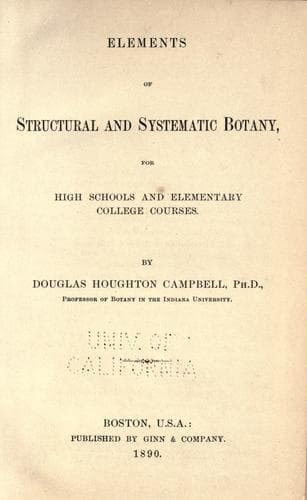
Elements of Structural and Systematic Botany: For High Schools and Elementary College CoursesCampbell, Douglas Houghton
Science
Elements of Structural and Systematic Botany: For High Schools and Elementary College Courses
Campbell, Douglas Houghton
Botany -- Textbooks
The _Scrophularineæ_ differ mainly from the _Labiatæ_ in having round
stems, and the ovary not splitting into separate one-seeded fruits.
The leaves are also sometimes alternate. There are generally four
stamens, two long and two short, as in the labiates, but in the
mullein (_Verbascum_) (Fig. 120, _M_), where the flower is only
slightly zygomorphic, there is a fifth rudimentary stamen, while in
others (_e.g._ _Veronica_) (Fig. 120, _J_) there are but two stamens.
Many have large, showy flowers, as in the cultivated foxglove
(_Digitalis_), and the native species of _Gerardia_, mullein,
_Mimulus_, etc., while a few like the figwort, _Scrophularia_
(Fig. 120, _H_), and speedwells (_Veronica_) have duller-colored or
smaller flowers.
[Illustration: FIG. 121.--_Anisocarpous sympetalæ_ (_Labiatifloræ_).
_A_, flowering branch of trumpet-creeper, _Tecoma_ (_Bignoniaceæ_),
× ¼. _B_, a single flower, divided lengthwise, × ½. _C_, cross-section
of the ovary, × 2. _D_, diagram of the flower. _E_, flower of vervain,
_Verbena_ (_Verbenæ_), × 2: i, from the side; ii, from in front; iii,
the corolla laid open. _F_, nearly ripe fruit of the same, × 2. _G_,
part of a spike of flowers of the common plantain, _Plantago_
(_Plantagineæ_), × 1; The upper flowers have the pistils mature, but
the stamens are not yet ripe. _H_, a flower from the upper (younger)
part of the spike. _I_, an older expanded flower, with ripe stamens,
× 3.]
The curious bladder-weed (_Utricularia_) is the type of the family
_Lentibulariaceæ_, aquatic or semi-aquatic plants which possess
special contrivances for capturing insects or small water animals.
These in the bladder-weed are little sacs (Fig. 120, _P_) which act as
traps from which the animals cannot escape after being captured. There
does not appear to be here any actual digestion, but simply an
absorption of the products of decomposition, as in the pitcher-plant.
In the nearly related land form, _Pinguicula_, however, there is much
the same arrangement as in the sundew.
The family _Gesneraceæ_ is mainly a tropical one, represented in the
greenhouses by the magnificent _Gloxinia_ and _Achimenes_, but of
native plants there are only a few parasitic forms destitute of
chlorophyll and with small, inconspicuous flowers. The commonest of
these is _Epiphegus_, a much-branched, brownish plant, common in
autumn about the roots of beech-trees upon which it is parasitic, and
whence it derives its common name, "beech-drops."
The bignonia family (_Bignoniaceæ_) is mainly tropical, but in our
southern states is represented by the showy trumpet-creeper (_Tecoma_)
(Fig. 121, _A_), the catalpa, and _Martynia_.
Public-domain text, read in full here on John Shaqi.
Reviews
Reviews
No reviews yet
Be the first to share your thoughts on this work.
Elsewhere in the archive
Join the Discussion
Join the discussion
Sign in to leave a comment or review.
Sign InorCreate an account