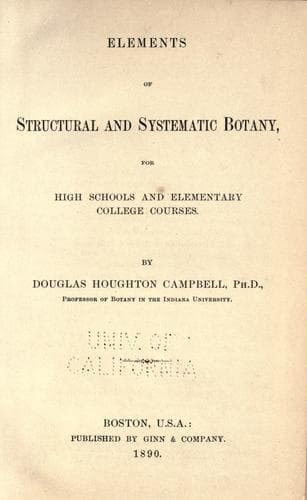
Elements of Structural and Systematic Botany: For High Schools and Elementary College CoursesCampbell, Douglas Houghton
Science
Elements of Structural and Systematic Botany: For High Schools and Elementary College Courses
Campbell, Douglas Houghton
Botany -- Textbooks
[Illustration: FIG. 123.--_Anisocarpous sympetalæ_ (_Campanulinæ_).
_A_, vertical section of the bud of American bell-flower, _Campanula_
(_Campanulaceæ_), × 2. _B_, an expanded flower, × 1. The stamens have
discharged their pollen, and the stigma has opened. _C_, cross-section
of the ovary, × 3. _D_, flower of the Carpathian bell-flower
(_Campanula Carpatica_), × 1. _E_, flower of cardinal-flower,
_Lobelia_ (_Lobeliaceæ_), × 1. _F_, the same, with the corolla and
sepals removed. _an._ the united anthers. _gy._ the tip of the pistil.
_G_, the tip of the pistil, × 2, showing the circle of hairs
surrounding the stigma. _H_, cross-section of the ovary, × 3. _I_, tip
of a branch of cucumber, _Cucurbita_ (_Cucurbitaceæ_), with an
expanded female flower (♀). _J_, andrœcium of a male flower, showing
the peculiar convoluted anthers (_an._), × 2. _K_, cross-section of
the ovary, × 2.]
The fourth order (_Campanulinæ_) also embraces five families, but of
these only three are represented among our wild plants. The
bell-flowers (_Campanula_) (Fig. 123, _A_, _D_) are examples of the
family _Campanulaceæ_, and numerous species are common, both wild and
cultivated.
[Illustration: FIG. 124.--_Anisocarpous sympetalæ_ (_Aggregatæ_). _A_,
flowering branch of _Houstonia purpurea_, × 1 (_Rubiaceæ_). _B_,
vertical section of a flower, × 2. _C_, fruit of bluets (_Houstonia
cœrulea_), × 1. _D_, cross-section of the same. _E_, bedstraw,
_Galium_ (_Rubiaceæ_), × ½. _F_, a single flower, × 2. _G_, flower of
arrow-wood, _Viburnum_ (_Caprifoliaceæ_), × 2. _H_, the same, divided
vertically. _I_, flowering branch of trumpet honeysuckle, _Lonicera_
(_Caprifoliaceæ_), × ½. _J_, a single flower, the upper part laid
open, × 1. _K_, diagram of the flower. _L_, part of the inflorescence
of valerian, _Valeriana_, (_Valerianeæ_), × 1. _M_, young; _N_, older
flower, × 2. _O_, cross-section of the young fruit; one division of
the three contains a perfect seed, the others are crowded to one side
by its growth. _P_, inflorescence of teasel, _Dipsacus_ (_Dipsaceæ_),
× ¼. _fl._ flowers. _Q_, a single flower, × 1. _R_, the same, with the
corolla laid open.]
The various species of _Lobelia_, of which the splendid
cardinal-flower (_L. Cardinalis_) (Fig. 123, _E_) is one of the most
beautiful, represent the very characteristic family _Lobeliaceæ_.
Their milky juice contains more or less marked poisonous properties.
The last family of the order is the gourd family (_Cucurbitaceæ_),
represented by a few wild species, but best known by the many
cultivated varieties of melons, cucumbers, squashes, etc. They are
climbing or running plants, and provided with tendrils. The flowers
are usually unisexual, sometimes diœcious, but oftener monœcious
(Fig. 123, _I_).
Public-domain text, read in full here on John Shaqi.
Reviews
Reviews
No reviews yet
Be the first to share your thoughts on this work.
Elsewhere in the archive
Join the Discussion
Join the discussion
Sign in to leave a comment or review.
Sign InorCreate an account