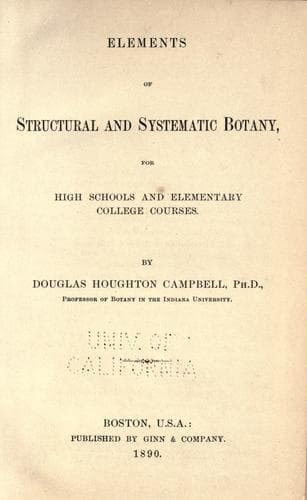
Elements of Structural and Systematic Botany: For High Schools and Elementary College CoursesCampbell, Douglas Houghton
Science
Elements of Structural and Systematic Botany: For High Schools and Elementary College Courses
Campbell, Douglas Houghton
Botany -- Textbooks
The simple method of fixing and staining, just described, while giving
excellent results in many cases, is not always applicable, nor as a
rule are the permanent preparations so made satisfactory. For
permanent preparations, strong alcohol (for very delicate tissues,
absolute alcohol, when procurable, is best) is the most convenient
fixing agent, and generally very satisfactory. Specimens may be put
directly into the alcohol, and allowed to stay two or three days, or
indefinitely if not wanted immediately. When alcohol does not give
good results, specimens fixed with chromic or picric acid may
generally be used, and there are other fixing agents which will not be
described here, as they will hardly be used by any except the
professional botanist. Chromic acid is best used in a watery solution
(five per cent chromic acid, ninety-five per cent distilled water).
For most purposes a one per cent solution is best; in this the objects
remain from three or four to twenty-four hours, depending on size, but
are not injured by remaining longer. Picric acid is used as a
saturated solution in distilled water, and the specimen may remain for
about the same length of time as in the chromic acid. After the
specimen is properly fixed it must be thoroughly washed in several
waters, allowing it to remain in the last for twenty-four hours or
more until all trace of the acid has been removed, otherwise there is
usually difficulty in staining.
As staining agents many colors are used. The most useful are
hæmatoxylin, carmine, and various aniline colors, among which may be
mentioned, besides gentian violet, safranine, Bismarck brown, methyl
violet. Hæmatoxylin and carmine are prepared in various ways, but are
best purchased ready for use, all dealers in microscopic supplies
having them in stock. The aniline colors may be used either dissolved
in alcohol or water, and with all, the best stain, especially of the
nucleus, is obtained by using a very dilute, watery solution, and
allowing the sections to remain for twenty-four hours or so in the
staining mixture.
Hæmatoxylin and carmine preparations may be mounted either in
glycerine or balsam. (Canada balsam dissolved in chloroform is the
ordinary mounting medium.) In using glycerine it is sometimes
necessary to add the glycerine gradually, allowing the water to slowly
evaporate, as otherwise the specimens will sometimes collapse owing to
the too rapid extraction of the water from the cells. Aniline colors,
as a rule, will not keep in glycerine, the color spreading and finally
fading entirely, so that with most of them the specimens must be
mounted in balsam.
Glycerine mounts must be closed, which may be done with Canada balsam
as already described. The balsam is best kept in a wide-mouthed
bottle, specially made for the purpose, which has a glass cap covering
the neck, and contains a glass rod for applying the balsam.
Public-domain text, read in full here on John Shaqi.
Reviews
Reviews
No reviews yet
Be the first to share your thoughts on this work.
Elsewhere in the archive
Join the Discussion
Join the discussion
Sign in to leave a comment or review.
Sign InorCreate an account