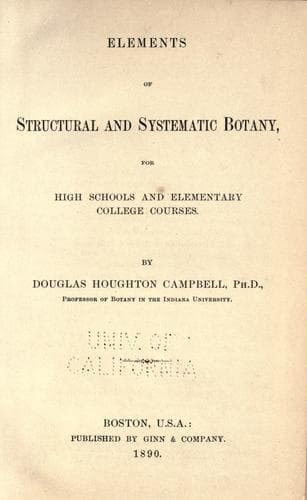
Elements of Structural and Systematic Botany: For High Schools and Elementary College CoursesCampbell, Douglas Houghton
Science
Elements of Structural and Systematic Botany: For High Schools and Elementary College Courses
Campbell, Douglas Houghton
Botany -- Textbooks
Before mounting in balsam, the specimen must be completely freed from
water by means of absolute alcohol. (Sometimes care must be taken to
bring it gradually into the alcohol to avoid collapsing.[16]) If an
aniline stain has been used, it will not do to let it stay more than a
minute or so in the alcohol, as the latter quickly extracts the stain.
After dehydrating, the specimen should be placed on a clean slide in a
drop of clove oil (bergamot or origanum oil is equally good), which
renders it perfectly transparent, when a drop of balsam should be
dropped upon it, and a perfectly clean cover glass placed over the
preparation. The chloroform in which the balsam is dissolved will soon
evaporate, leaving the object embedded in a transparent film of balsam
between the slide and cover glass. No further treatment is necessary.
For the finer details of nuclear division or similar studies, balsam
mounts are usually preferable.
[16] For gradual dehydrating, the specimens may be placed
successively in 30 per cent, 50 per cent, 70 per cent, 90 per cent,
and absolute alcohol.
It is sometimes found necessary in sectioning very small and delicate
organs to embed them in some firm substance which will permit
sectioning, but these processes are too difficult and complicated to
be described here.
* * * * *
The following books of reference may be recommended. This list is, of
course, not exhaustive, but includes those works which will probably
be of most value to the general student.
1. GOEBEL. Outlines of Morphology and Classification.
2. SACHS. Physiology of Plants.
3. DE BARY. Comparative Anatomy of Ferns and Phanerogams.
4. DE BARY. Morphology and Biology of Fungi, Mycetozoa, and Bacteria.
These four works are translations from the German, and take the
place of Sachs's Text-book of Botany, a very admirable work
published first about twenty years ago, and now somewhat antiquated.
Together they constitute a fairly exhaustive treatise on general
botany.--New York, McMillan & Co.
5. GRAY. Structural Botany.--New York, Ivison & Co.
6. GOODALE. Physiological Botany.--New York, Ivison & Co.
These two books cover somewhat the same ground as 1 and 2, but are
much less exhaustive.
5. STRASBURGER. Das Botanische Practicum.--Jena.
Where the student reads German, the original is to be preferred, as
it is much more complete than the translations, which are made from
an abridgment of the original work. This book and the next (7 and 8)
are laboratory manuals, and are largely devoted to methods of work.
7. ARTHUR, BARNES, and COULTER. Plant Dissection.--Holt & Co., New
York.
8. WHITMAN. Methods in Microscopic Anatomy and Embryology.--Casino
& Co., Boston.
For identifying plants the following books may be mentioned:--
Green algæ (exclusive of desmids, but including _Cyanophyceæ_ and
_Volvocineæ_).
WOLLE. Fresh-water Algæ of the United States.--Bethlehem, Penn.
Public-domain text, read in full here on John Shaqi.
Reviews
Reviews
No reviews yet
Be the first to share your thoughts on this work.
Elsewhere in the archive
Join the Discussion
Join the discussion
Sign in to leave a comment or review.
Sign InorCreate an account