Elements of Structural and Systematic Botany: For High Schools and Elementary College Courses — John Shaqi
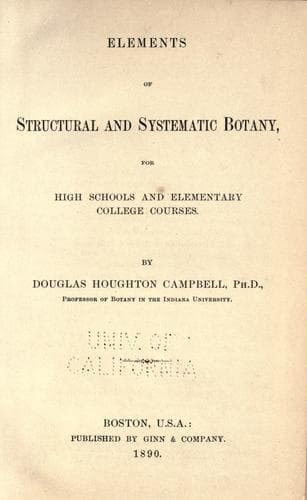
Elements of Structural and Systematic Botany: For High Schools and Elementary College CoursesCampbell, Douglas Houghton
Science
Elements of Structural and Systematic Botany: For High Schools and Elementary College Courses
Campbell, Douglas Houghton
Botany -- Textbooks
The sexual reproduction takes place as follows: Certain cells of a
filament become distinguished by their denser contents and by an
increase in size, becoming oval or nearly globular in form (Fig. 16,
_A_, _B_). When fully grown, the contents contract and form a naked
cell, which sometimes shows a clear area at one point on the
surface. This globular mass of protoplasm is the egg cell, or female
cell, and the cell containing it is called the "oögonium." When the
egg cell is ripe, the oögonium opens by means of a little pore at
one side (Fig. 16, _A_).
In other cells, either of the same filament or else of the small
male plants already mentioned, small motile cells, called
spermatozoids, are formed. These are much smaller than the egg cell,
and resemble the zoöspores in form, but are much smaller, and
without chlorophyll. When ripe they are discharged from the cells in
which they were formed, and enter the oögonium. By careful
observation the student may possibly be able to follow the
spermatozoid into the oögonium, where it enters the egg cell at the
clear spot on its surface. As a result of the entrance of the
spermatozoid (fertilization), the egg cell becomes surrounded by a
thick brown wall, and becomes a resting spore. The spore loses its
green color, and the wall becomes dark colored and differentiated
into several layers, the outer one often provided with spines
(Fig. 16, _F_). As these spores do not germinate for a long time,
the process is only known in a comparatively small number of
species, and can hardly be followed by the ordinary student.
[Illustration: FIG. 17.--_A_, plant of _Coleochæte_, × 50. _B_, a few
cells from the margin, with one of the hairs.]
Much like _Œdogonium_, but differing in being branched, is the genus
_Bulbochæte_, characterized also by hairs swollen at the base, and
prolonged into a delicate filament (Fig. 16, _G_).
The highest members of the _Confervaceæ_ are those of the genus
_Coleochæte_ (Fig. 17), of which there are several species found in
the United States. These show some striking resemblances to the red
seaweeds, and possibly form a transition from the green algæ to the
red. The commonest species form bright-green discs, adhering firmly
to the stems and floating leaves of water lilies and other aquatics.
In aquaria they sometimes attach themselves in large numbers to the
glass sides of the vessel.
Growing from the upper surface are numerous hairs, consisting of a
short, sheath-like base, including a very long and delicate filament
(Fig. 17, _B_). In their methods of reproduction they resemble
_Œdogonium_, but the reproductive organs are more specialized.
CHAPTER V.
GREEN ALGÆ--_Continued_.
ORDER III.--POND SCUMS (_Conjugatæ_).
Public-domain text, read in full here on John Shaqi.
Reviews
Reviews
No reviews yet
Be the first to share your thoughts on this work.
Join the Discussion
Join the discussion
Sign in to leave a comment or review.
Sign InorCreate an account