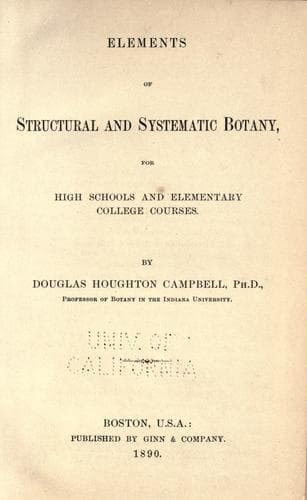
Elements of Structural and Systematic Botany: For High Schools and Elementary College CoursesCampbell, Douglas Houghton
Science
Elements of Structural and Systematic Botany: For High Schools and Elementary College Courses
Campbell, Douglas Houghton
Botany -- Textbooks
In addition to the implements used in studying the gross anatomy, the
following will be found useful in histological work: 1. a small
camel's-hair brush for picking up small sections and putting water in
the slides; 2. small forceps for handling delicate objects; 3.
blotting paper for removing superfluous water from the slides and
drawing fluids under the cover glass; 4. pieces of elder or sunflower
pith, for holding small objects while making sections.
In addition to these implements, a few reagents may be recommended for
the simpler histological work. The most important of these are
alcohol, glycerine, potash (a strong solution of potassium hydrate in
water), iodine (either a little of the commercial tincture of iodine
in water, or, better, a solution of iodine in iodide of potassium),
acetic acid, and some staining fluid. (An aqueous or alcoholic
solution of gentian violet or methyl violet is one of the best.)
A careful record should be kept by the student of all work done, both
by means of written notes and drawings. For most purposes pencil
drawings are most convenient, and these should be made with a
moderately soft pencil on unruled paper. If it is desired to make the
drawings with ink, a careful outline should first be made with a hard
pencil and this inked over with India-ink or black drawing ink. Ink
drawings are best made upon light bristol board with a hard,
smooth-finished surface.
When obtainable, the student will do best to work with freshly
gathered specimens; but as these are not always to be had when wanted,
a few words about gathering and preserving material may be of service.
Most of the lower green plants (_algæ_) may be kept for a long time in
glass jars or other vessels, provided care is taken to remove all
dead specimens at first and to renew the water from time to time. They
usually thrive best in a north window where they get little or no
direct sunshine, and it is well to avoid keeping them too warm.
Numbers of the most valuable fungi--_i.e._ the lower plants that are
not green--grow spontaneously on many organic substances that are kept
warm and moist. Fresh bread kept moist and covered with a glass will
in a short time produce a varied crop of moulds, and fresh horse
manure kept in the same way serves to support a still greater number
of fungi.
Mosses, ferns, etc., can be raised with a little care, and of course
very many flowering plants are readily grown in pots.
Most of the smaller parasitic fungi (rusts, mildews, etc.) may be kept
dry for any length of time, and on moistening with a weak solution of
caustic potash will serve nearly as well as freshly gathered specimens
for most purposes.
When it is desired to preserve as perfectly as possible the more
delicate plant structures for future study, strong alcohol is the best
and most convenient preserving agent. Except for loss of color it
preserves nearly all plant tissues perfectly.
CHAPTER II.
THE CELL.
Public-domain text, read in full here on John Shaqi.
Reviews
Reviews
No reviews yet
Be the first to share your thoughts on this work.
Join the Discussion
Join the discussion
Sign in to leave a comment or review.
Sign InorCreate an account