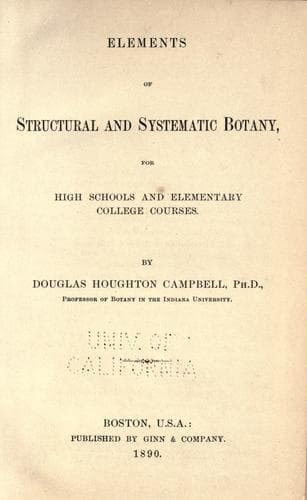
Elements of Structural and Systematic Botany: For High Schools and Elementary College CoursesCampbell, Douglas Houghton
Science
Elements of Structural and Systematic Botany: For High Schools and Elementary College Courses
Campbell, Douglas Houghton
Botany -- Textbooks
The apices of the stem and leaves, being otherwise protected,
develop segments only from the sides of the apical cell, the outer
face never having segments cut off from it.
CHAPTER XIII.
CLASSIFICATION OF THE PTERIDOPHYTES.
There are three well-marked classes of the Pteridophytes: the ferns
(_Filicinæ_); horse-tails (_Equisetinæ_); and the club mosses
(_Lycopodinæ_).
CLASS I.--FERNS (_Filicinæ_).
The ferns constitute by far the greater number of pteridophytes, and
their general structure corresponds with that of the maiden-hair fern
described. There are three orders, of which two, the true ferns
(_Filices_) and the adder-tongues (_Ophioglossaceæ_), are represented
in the United States. A third order, intermediate in some respects
between these two, and called the ringless ferns (_Marattiaceæ_), has
no representatives within our territory.
The classification is at present based largely upon the characters of
the sporophyte, the sexual plants being still very imperfectly known
in many forms.
The adder-tongues (_Ophioglossaceæ_) are mostly plants of rather small
size, ranging from about ten to fifty centimetres in height. There are
two genera in the United States, the true adder-tongues
(_Ophioglossum_) and the grape ferns (_Botrychium_). They send up but
one leaf each year, and this in fruiting specimens (Fig. 70, _A_) is
divided into two portions, the spore bearing (_x_) and the green
vegetative part. In _Botrychium_ the leaves are more or less deeply
divided, and the sporangia distinct (Fig. 71, _B_). In _Ophioglossum_
the sterile division of the leaf is usually smooth and undivided, and
the spore-bearing division forms a sort of spike, and the sporangia
are much less distinct. The sporangia in both differ essentially from
those of the true ferns in not being derived from a single epidermal
cell, but are developed in part from the ground tissue of the leaf.
[Illustration: FIG. 70.--Forms of ferns. _A_, grape fern
(_Botrychium_), × ½. _x_, fertile part of the leaf. _B_, sporangia of
_Botrychium_, × 3. _C_, flowering fern (_Osmunda_). _x_, spore-bearing
leaflets, × ½. _D_, a sporangium of _Osmunda_, × 25. _r_, ring. _E_,
_Polypodium_, × 1. _F_, brake (_Pteris_), × 1. _G_, shield fern
(_Aspidium_), × 2. _H_, spleen-wort (_Asplenium_), × 2. _I_, ostrich
fern (_Onoclea_), × 1. _J_, the same, with the incurved edges of the
leaflet partially raised so as to show the masses of sporangia
beneath, × 2.]
In the true ferns (_Filices_), the sporangia resemble those already
described, arising in all (unless possibly _Osmunda_) from a single
epidermal cell.
Public-domain text, read in full here on John Shaqi.
Reviews
Reviews
No reviews yet
Be the first to share your thoughts on this work.
Elsewhere in the archive
Join the Discussion
Join the discussion
Sign in to leave a comment or review.
Sign InorCreate an account