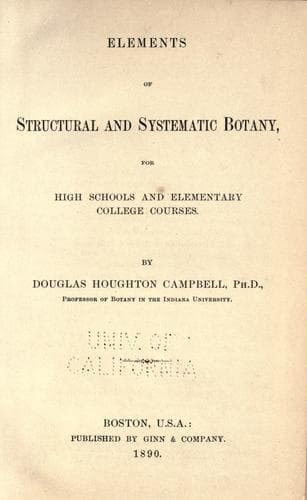
Elements of Structural and Systematic Botany: For High Schools and Elementary College CoursesCampbell, Douglas Houghton
Science
Elements of Structural and Systematic Botany: For High Schools and Elementary College Courses
Campbell, Douglas Houghton
Botany -- Textbooks
Resembling the smaller club mosses in their development, but differing
in some important points, are the quill-worts (_Isoeteæ_). They are
mostly aquatic forms, growing partially or completely submerged, and
look like grasses or rushes. They vary from a few centimetres to half
a metre in height. The stem is very short, and the long cylindrical
leaves closely crowded together. The leaves which are narrow above are
widely expanded and overlapping at the base. The spores are of two
kinds, as in _Selaginella_, but the macrosporangia contain numerous
macrospores. The very large sporangia (_M_, _sp._) are in cavities at
the bases of the leaves, and above each sporangium is a little pointed
outgrowth (ligula), which is also found in the leaves of
_Selaginella_. The quill-worts are not common plants, and owing to
their habits of growth and resemblance to other plants, are likely to
be overlooked unless careful search is made.
CHAPTER XIV.
SUB-KINGDOM VI.
SPERMAPHYTES: PHÆNOGAMS.
The last and highest great division of the vegetable kingdom has been
named _Spermaphyta_, "seed plants," from the fact that the structures
known as seeds are peculiar to them. They are also commonly called
flowering plants, though this name might be also appropriately given
to certain of the higher pteridophytes.
In the seed plants the macrosporangia remain attached to the parent
plant, in nearly all cases, until the archegonia are fertilized and
the embryo plant formed. The outer walls of the sporangium now become
hard, and the whole falls off as a seed.
In the higher spermaphytes the spore-bearing leaves (sporophylls)
become much modified, and receive special names, those bearing the
microspores being commonly known as stamens; those bearing the
macrospores, carpels or carpophylls. The macrosporangia are also
ordinarily known as "ovules," a name given before it was known that
these were the same as the macrosporangia of the higher pteridophytes.
In addition to the spore-bearing leaves, those surrounding them may be
much changed in form and brilliantly colored, forming, with the
enclosed sporophylls, the "flower" of the higher spermaphytes.
As might be expected, the tissues of the higher spermaphytes are the
most highly developed of all plants, though some of them are very
simple. The plants vary extremely in size, the smallest being little
floating plants, less than a millimetre in diameter, while others are
gigantic trees, a hundred metres and more in height.
There are two classes of the spermaphytes: I., the Gymnosperms, or
naked-seeded ones, in which the ovules (macrosporangia) are borne upon
open carpophylls; and II., Angiosperms, covered-seeded plants, in
which the carpophylls form a closed cavity (ovary) containing the
ovules.
CLASS I.--GYMNOSPERMS (_Gymnospermæ_).
Public-domain text, read in full here on John Shaqi.
Reviews
Reviews
No reviews yet
Be the first to share your thoughts on this work.
Elsewhere in the archive
Join the Discussion
Join the discussion
Sign in to leave a comment or review.
Sign InorCreate an account