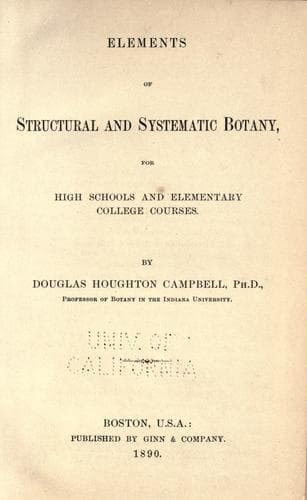
Elements of Structural and Systematic Botany: For High Schools and Elementary College CoursesCampbell, Douglas Houghton
Science
Elements of Structural and Systematic Botany: For High Schools and Elementary College Courses
Campbell, Douglas Houghton
Botany -- Textbooks
The most familiar of these plants are the common evergreen trees
(conifers), pines, spruces, cedars, etc. A careful study of one of
these will give a good idea of the most important characteristics of
the class, and one of the best for this purpose is the Scotch pine
(_Pinus sylvestris_), which, though a native of Europe, is not
infrequently met with in cultivation in America. If this species
cannot be had by the student, other pines, or indeed almost any other
conifer, will answer. The Scotch pine is a tree of moderate size,
symmetrical in growth when young, with a central main shaft, and
circles of branches at regular intervals; but as it grows older its
growth becomes irregular, and the crown is divided into several main
branches.[10] The trunk and branches are covered with a rough, scaly
bark of a reddish brown color, where it is exposed by the scaling off
of the outer layers. Covering the younger branches, but becoming
thinner on the older ones, are numerous needle-shaped leaves. These
are in pairs, and the base of each pair is surrounded by several dry,
blackish scales. Each pair of leaves is really attached to a very
short side branch, but this is so short as to make the leaves appear
to grow directly from the main branch. Each leaf is about ten
centimetres in length and two millimetres broad. Where the leaves are
in contact they are flattened, but the outer side is rounded, so that
a cross-section is nearly semicircular in outline. With a lens it is
seen that there are five longitudinal lines upon the surface of the
leaf, and careful examination shows rows of small dots corresponding
to these. These dots are the breathing pores. If a cross-section is
even slightly magnified it shows three distinct parts,--a whitish
outer border, a bright green zone, and a central oval, colorless area,
in which, with a little care, may be seen the sections of two
fibro-vascular bundles. In the green zone are sometimes to be seen
colorless spots, sections of resin ducts, containing the resin so
characteristic of the tissues of the conifers.
[10] In most conifers the symmetrical form of the young tree is
maintained as long as the tree lives.
Public-domain text, read in full here on John Shaqi.
Reviews
Reviews
No reviews yet
Be the first to share your thoughts on this work.
Elsewhere in the archive
Join the Discussion
Join the discussion
Sign in to leave a comment or review.
Sign InorCreate an account