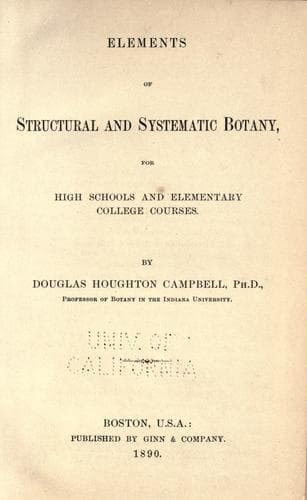
Elements of Structural and Systematic Botany: For High Schools and Elementary College CoursesCampbell, Douglas Houghton
Science
Elements of Structural and Systematic Botany: For High Schools and Elementary College Courses
Campbell, Douglas Houghton
Botany -- Textbooks
In longitudinal sections, the cells, except of the mesophyll (green
tissue) are much elongated. The mesophyll cells, however, are short
and the intercellular spaces much more evident than in the
cross-section. The colorless cells have frequently rounded
depressions or pits upon their walls, and in the fibro-vascular
bundle the difference between the two portions becomes more obvious.
The wood is distinguished by the presence of vessels with close,
spiral or ring-shaped thickenings, while in the phloem are found
sieve tubes, not unlike those in the ferns.
The fibro-vascular bundles of the stem of the seedling plant show a
structure quite similar to that of the leaf, but very soon a
difference is manifested. Between the two parts of the bundle the
cells continue to divide and add constantly to the size of the
bundle, and at the same time the bundles become connected by a line
of similar growing cells, so that very early we find a ring of
growing cells extending completely around the stem. As the cells in
this ring increase in number, owing to their rapid division, those
on the borders of the ring lose the power of dividing, and gradually
assume the character of the cells on which they border (Fig. 76,
_B_, _cam._). The growth on the inside of the ring is more rapid
than on the outer border, and the ring continues comparatively near
the surface of the stem (Fig. 76, _A_, _cam._). The spaces between
the bundles do not increase materially in breadth, and as the
bundles increase in size become in comparison very small, appearing
in older stems as mere lines between the solid masses of wood that
make up the inner portion of the bundles. These are the primary
medullary rays, and connect the pith in the centre of the stem with
the bark. Later, similar plates of cells are formed, often only a
single cell thick, and appearing when seen in cross-section as a
single row of elongated cells (_C_, _m_).
As the stem increases in diameter the bundles become broader and
broader toward the outside, and taper to a point toward the centre,
appearing wedge-shaped, the inner ends projecting into the pith. The
outer limits of the bundles are not nearly so distinct, and it is
not easy to tell when the phloem of the bundles ends and the ground
tissue of the bark begins.
Public-domain text, read in full here on John Shaqi.
Reviews
Reviews
No reviews yet
Be the first to share your thoughts on this work.
Elsewhere in the archive
Join the Discussion
Join the discussion
Sign in to leave a comment or review.
Sign InorCreate an account