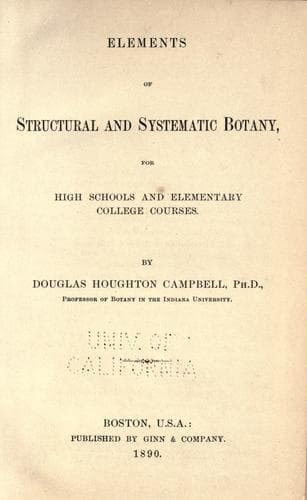
Elements of Structural and Systematic Botany: For High Schools and Elementary College CoursesCampbell, Douglas Houghton
Science
Elements of Structural and Systematic Botany: For High Schools and Elementary College Courses
Campbell, Douglas Houghton
Botany -- Textbooks
The young plant has a circle of leaves, about six in number,
surrounding a bud which is the growing point of the stem, and in many
conifers persists as long as the stem grows (Fig. 75, _K_, _b_). A
cross-section of the young stem shows about six separate
fibro-vascular bundles arranged in a circle (_S_, _fb._). The root
shows a central fibro-vascular cylinder surrounded by a dark-colored
ground tissue. Growing from its surface are numerous root hairs
(Fig. 75, _M_).
For examining the microscopic structure of the pine, fresh material
is for most purposes to be preferred, but alcoholic material will
answer, and as the alcohol hardens the resin, it is for that reason
preferable.
Cross-sections of the leaf, when sufficiently magnified, show that
the outer colorless border of the section is composed of two parts:
the epidermis of a single row of regular cells with very thick outer
walls, and irregular groups of cells lying below them. These latter
have thick walls appearing silvery and clearer than the epidermal
cells. They vary a good deal, in some leaves being reduced to a
single row, in others forming very conspicuous groups of some size.
The green tissue of the leaf is much more compact than in the fern
we examined, and the cells are more nearly round and the
intercellular spaces smaller. The chloroplasts are numerous and
nearly round in shape.
Scattered through the green tissue are several resin passages (_r_),
each surrounded by a circle of colorless, thick-walled cells, like
those under the epidermis. At intervals in the latter are
openings--breathing pores--(Fig. 76, _J_), below each of which is an
intercellular space (_i_). They are in structure like those of the
ferns, but the walls of the guard cells are much thickened like the
other epidermal cells.
Each leaf is traversed by two fibro-vascular bundles of entirely
different structure from those of the ferns. Each is divided into
two nearly equal parts, the wood (_x_) lying toward the inner, flat
side of the leaf, the bast (_T_) toward the outer, convex side. This
type of bundle, called "collateral," is the common form found in the
stems and leaves of seed plants. The cells of the wood or xylem are
rather larger than those of the bast or phloem, and have thicker
walls than any of the phloem cells, except the outermost ones which
are thick-walled fibres like those under the epidermis. Lying
between the bundles are comparatively large colorless cells, and
surrounding the whole central area is a single line of cells that
separates it sharply from the surrounding green tissue.
Public-domain text, read in full here on John Shaqi.
Reviews
Reviews
No reviews yet
Be the first to share your thoughts on this work.
Elsewhere in the archive
Join the Discussion
Join the discussion
Sign in to leave a comment or review.
Sign InorCreate an account