Produced by Audrey Longhurst, Martin Pettit and the Online
Distributed Proofreading Team at http://www.pgdp.net (This
book was produced from scanned images of public domain
material from the Google Print project.)
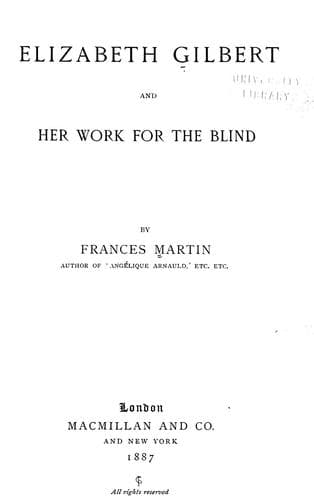
ELIZABETH GILBERT
[Illustration: Logo]
[Illustration: (signed) Elizabeth Gilbert]
ELIZABETH GILBERT AND HER WORK FOR THE BLIND
BY FRANCES MARTIN
AUTHOR OF 'ANGELIQUE ARNAULD,' ETC. ETC.
London
MACMILLAN AND CO.
AND NEW YORK
1887
_All rights reserved_
INTRODUCTION
There is a sacred privacy in the life of a blind person. It is led apart
from much of the ordinary work of the world, and is unaffected by many
external incidents which help to make up the important events of other
lives. It is passed in the shade and not in the open sunlight of eager
activity. At first we should be disposed to say that such a life, with
its inevitable restrictions and compulsory isolation, could offer little
of public interest, and might well remain unchronicled. But in the rare
cases where blindness, feeble health, and suffering form scarcely any
bar to activity; where they are not only borne with patience, but by
heroic effort are compelled to minister to great aims, we are eager to
learn the secret of such a life. No details connected with it are devoid
of interest; and we are stimulated, encouraged, and strengthened by
seeing obstacles overcome which appeared insurmountable, and watching
triumph where we dreaded defeat.
Elizabeth Gilbert was born at a time when kindly and intelligent men
and women could gravely implore "the Almighty" to "take away" a child
merely because it was blind; when they could argue that to teach the
blind to read, or to attempt to teach them to work, was to fly in the
face of Providence. And her whole life was given to the endeavour to
overcome prejudice and superstition; to show that blindness, though a
great privation, is not a disqualification. Blind men and women can
learn, labour, and fulfil all the duties of life if their fellow-men are
merciful and helpful, and God is on the side of all those who work
honestly for themselves and others.
The life of Elizabeth Gilbert and her work for the blind are so
inextricably interwoven, that it is impossible to tell one without
constant reference to the other.
A small cellar in Holborn at a rent of eighteen-pence a week was enough
for a beginning. But before her death she could point to large and
well-appointed workshops in almost every city of England, where blind
men and women are employed, where tools have been invented by or
modified for them, where agencies have been established for the sale of
their work.
Her example has encouraged, her influence has promoted the work which
she never relinquished throughout life.
Nothing was too great for her to attempt on behalf of the blind, nothing
seemed impossible of achievement. One success suggested a new endeavour,
one achievement opened a door for fresh effort.
Public-domain text, read in full here on John Shaqi.
Reviews
Reviews
No reviews yet
Be the first to share your thoughts on this work.
Join the Discussion
Join the discussion
Sign in to leave a comment or review.
Sign InorCreate an account