Produced by David Widger
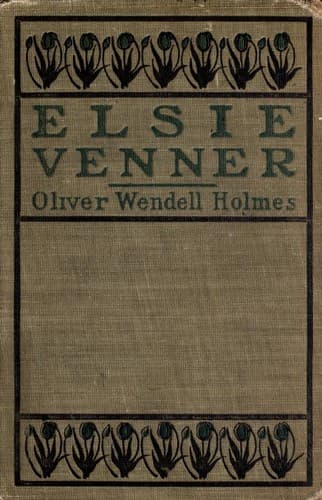
ELSIE VENNER
By Oliver Wendell Holmes
PREFACE.
This tale was published in successive parts in the “Atlantic Monthly,”
under the name of “The Professor's Story,” the first number having
appeared in the third week of December, 1859. The critic who is curious
in coincidences must refer to the Magazine for the date of publication
of the chapter he is examining.
In calling this narrative a “romance,” the Author wishes to make sure of
being indulged in the common privileges of the poetic license. Through
all the disguise of fiction a grave scientific doctrine may be detected
lying beneath some of the delineations of character. He has used this
doctrine as a part of the machinery of his story without pledging his
absolute belief in it to the extent to which it is asserted or implied.
It was adopted as a convenient medium of truth rather than as an
accepted scientific conclusion. The reader must judge for himself what
is the value of various stories cited from old authors. He must decide
how much of what has been told he can accept either as having actually
happened, or as possible and more or less probable. The Author must
be permitted, however, to say here, in his personal character, and as
responsible to the students of the human mind and body, that since
this story has been in progress he has received the most startling
confirmation of the possibility of the existence of a character like
that which he had drawn as a purely imaginary conception in Elsie
Venner.
BOSTON, January, 1861.
A SECOND PREFACE.
This is the story which a dear old lady, my very good friend, spoke of
as “a medicated novel,” and quite properly refused to read. I was always
pleased with her discriminating criticism. It is a medicated novel, and
if she wished to read for mere amusement and helpful recreation there
was no need of troubling herself with a story written with a different
end in view.
This story has called forth so many curious inquiries that it seems
worth while to answer the more important questions which have occurred
to its readers.
In the first place, it is not based on any well-ascertained
physiological fact. There are old fables about patients who have barked
like dogs or crowed like cocks, after being bitten or wounded by those
animals. There is nothing impossible in the idea that Romulus and Remus
may have imbibed wolfish traits of character from the wet nurse the
legend assigned them, but the legend is not sound history, and the
supposition is nothing more than a speculative fancy. Still, there is a
limbo of curious evidence bearing on the subject of pre-natal influences
sufficient to form the starting-point of an imaginative composition.
Public-domain text, read in full here on John Shaqi.
Reviews
Reviews
No reviews yet
Be the first to share your thoughts on this work.
Join the Discussion
Join the discussion
Sign in to leave a comment or review.
Sign InorCreate an account