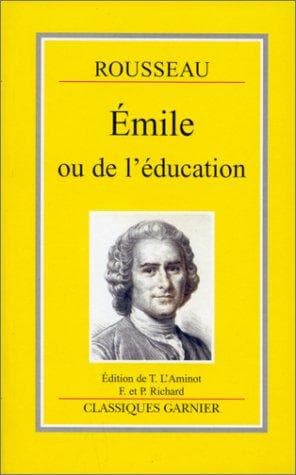
Never show a child what he cannot see. Since mankind is almost
unknown to him, and since you cannot make a man of him, bring the
man down to the level of the child. While you are thinking what
will be useful to him when he is older, talk to him of what he
knows he can use now. Moreover, as soon as he begins to reason let
there be no comparison with other children, no rivalry, no competition,
not even in running races. I would far rather he did not learn
anything than have him learn it through jealousy or self-conceit.
Year by year I shall just note the progress he had made, I shall
compare the results with those of the following year, I shall say,
"You have grown so much; that is the ditch you jumped, the weight
you carried, the distance you flung a pebble, the race you ran
without stopping to take breath, etc.; let us see what you can do
now."
In this way he is stimulated to further effort without jealousy.
He wants to excel himself as he ought to do; I see no reason why
he should not emulate his own performances.
I hate books; they only teach us to talk about things we know
nothing about. Hermes, they say, engraved the elements of science
on pillars lest a deluge should destroy them. Had he imprinted
them on men's hearts they would have been preserved by tradition.
Well-trained minds are the pillars on which human knowledge is most
deeply engraved.
Is there no way of correlating so many lessons scattered through
so many books, no way of focussing them on some common object, easy
to see, interesting to follow, and stimulating even to a child?
Could we but discover a state in which all man's needs appear in
such a way as to appeal to the child's mind, a state in which the
ways of providing for these needs are as easily developed, the
simple and stirring portrayal of this state should form the earliest
training of the child's imagination.
Eager philosopher, I see your own imagination at work. Spare yourself
the trouble; this state is already known, it is described, with
due respect to you, far better than you could describe it, at least
with greater truth and simplicity. Since we must have books, there
is one book which, to my thinking, supplies the best treatise on
an education according to nature. This is the first book Emile will
read; for a long time it will form his whole library, and it will
always retain an honoured place. It will be the text to which all
our talks about natural science are but the commentary. It will
serve to test our progress towards a right judgment, and it will
always be read with delight, so long as our taste is unspoilt. What
is this wonderful book? Is it Aristotle? Pliny? Buffon? No; it is
Robinson Crusoe.
Public-domain text, read in full here on John Shaqi.
Reviews
Reviews
No reviews yet
Be the first to share your thoughts on this work.
Elsewhere in the archive
Join the Discussion
Join the discussion
Sign in to leave a comment or review.
Sign InorCreate an account