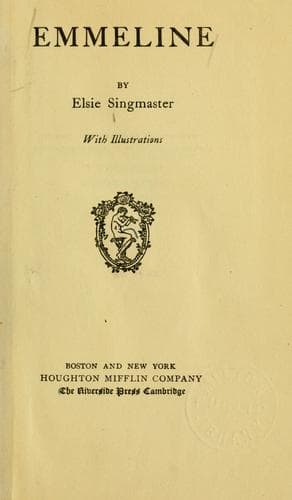
Gettysburg, Battle of, Gettysburg, Pa., 1863 -- Fiction; Pennsylvania -- History -- Civil War, 1861-1865 -- Fiction; War stories
Sister Bertha was, alas! a rebel. She had come from the South before
the war had broken out to teach school in a village near Gettysburg;
there young Henry Willing had seen her and had loved her, and nearly a
year ago had married her. It was an act not hard to understand after
you had seen Bertha. But it was war time, and between the two, in the
opinion of Emmeline, there should have been undying hatred instead of
love. Henry had already enlisted, and had gone away in his beautiful
blue uniform to join his regiment. He cherished the comfortable
conviction that his mother's home was still his, and thither he had
brought his bride. To Emmeline the act was subversive of all order; it
was contrary to the traditions of the world. Henry was, moreover, hers;
he did not belong to this pale, dark-eyed creature to whom she had to
carry trays.
To Emmeline's mother, Henry's marriage had brought great care. Soon
after Bertha had come to the old home she had been taken ill with a
slow fever, and had lain for weeks helpless in her bed. After a while
she had got better, and had been able to walk to the window and to look
out across the green fields toward the south, where two small hills
lifted rounded heads above the undulating fields.
"One is called Big Round Top and one Little Round Top," Emmeline had
explained in a rare moment of confidence. "There are queer rocks on Big
Round Top. One is shaped like George Washington's head, hat and all,
and there are two tremendous elephants, and there is Devil's Den. I
climbed through Devil's Den once when we went for a picnic. When we go
to grandfather's you can see it. At grandfather's there is a new calf,
and there is Willoughby Run, where I go fishing. I--"
At that point, Emmeline, reminding herself that she was holding
commerce with an enemy of her country, had stopped.
Emmeline's mother bore cheerfully the addition to her family. Bertha
was Henry's--that was reason enough; she was helpless, and she was,
besides, a very lovable person. Mrs Willing had begun bravely to make
quilts for Henry's setting up in housekeeping, and even poor Bertha
had tried to lift a needle in her slim, white fingers. Bertha could
pick lint, but she did not succeed in sewing. Now for two weeks she
had lain once more quiet and pale in her bed. Her improvement had been
inspired by Henry's letters; at the coming of one she had sat up;
at the coming of the second she had walked to the window. Suddenly,
alas! letters had ceased to arrive, and poor Bertha rose no more. The
neighbors--Mrs. Schmidt across the street, Mrs. Bannon next door--were
certain that Bertha could rise if she would. Mrs. Schmidt undertook to
condole with Mrs. Willing upon the difficulties of her situation. In
that Mrs. Schmidt was unwise. Mrs. Schmidt's husband was a sutler in
the army; and she had a great fear of his enemies.
"Ach, I pity you!" she cried in her German way. "She is strange to you
and a rebel to it yet!"
Public-domain text, read in full here on John Shaqi.
Reviews
Reviews
No reviews yet
Be the first to share your thoughts on this work.
Join the Discussion
Join the discussion
Sign in to leave a comment or review.
Sign InorCreate an account