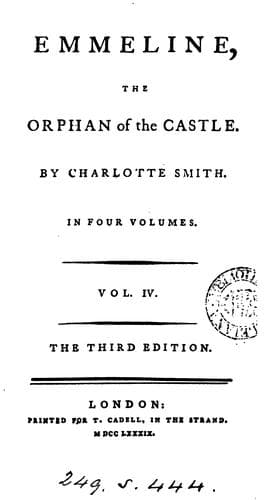
Emmeline, the Orphan of the CastleSmith, Charlotte
General
Emmeline, the Orphan of the Castle
Smith, Charlotte
Gothic fiction; Great Britain -- Social life and customs -- 18th century -- Fiction; Marriage -- Fiction; Single women -- Fiction
She therefore continued positively to refuse to appear to the party
below; and ordered the maid servant to bring her dinner into her own
room, which she never quitted 'till towards evening, to pursue her usual
walks.
On the third afternoon subsequent to the arrival of Mr. Delamere's
avant-couriers, Emmeline went down to the sea side, and seating herself
on a fragment of rock, fixed her eyes insensibly on the restless waves
that broke at her feet. The low murmurs of the tide retiring on the
sands; the sighing of the wind among the rocks which hung over her head,
cloathed with long grass and marine plants; the noise of the sea fowl
going to their nests among the cliffs; threw her into a profound
reverie.
She forgot awhile all her apprehended misfortunes, a sort of stupor took
possession of her senses, and she no longer remembered how the time had
passed there, which already exceeded two hours; though the moon, yet in
its encrease, was arisen, and threw a long line of radience on the
water.
Thus lost in indistinct reflections, she was unconscious of the
surrounding objects, when the hasty tread of somebody on the pebbles
behind her, made her suddenly recollect herself; and though accustomed
to be so much alone, she started in some alarm in remembering the late
hour, and the solitary place where she was.
A man approached her, in whom with satisfaction she recollected a young
peasant of the village, who was frequently employed in messages from the
castle.
'Miss Emmy,' said the lad, 'you are wanted at home; for there is my Lord
his own self, and the young Lord, and more gentlefolks come; so Madam
Garnet sent me to look for you all about.'
Emmeline, hurried by this intelligence, walked hastily away with the
young villager, and soon arrived at the castle.
The wind had blown her beautiful hair about her face, and the glow of
her cheeks was heightened by exercise and apprehension. A more lovely
figure than she now appeared could hardly be imagined. She had no time
to reflect on the interview; but hastened immediately into the parlour
where Lord Montreville was sitting with his son; Mr. Fitz-Edward, who
was a young officer, his friend, distantly related to the family; and
Mr. Headly, a man celebrated for his knowledge of rural improvements,
whom Lord Montreville had brought down to have his opinion of the
possibility of rendering Mowbray Castle a residence fit for his family
for a few months in the year.
Lord Montreville was about five and forty years old. His general
character was respectable. He had acquitted himself with honor in the
senate; and in private life had shewn great regularity and good conduct.
But he had basked perpetually in the sunshine of prosperity; and his
feelings, not naturally very acute, were blunted by having never
suffered in his own person any uneasiness which might have taught him
sensibility for that of others.
Public-domain text, read in full here on John Shaqi.
Reviews
Reviews
No reviews yet
Be the first to share your thoughts on this work.
Join the Discussion
Join the discussion
Sign in to leave a comment or review.
Sign InorCreate an account