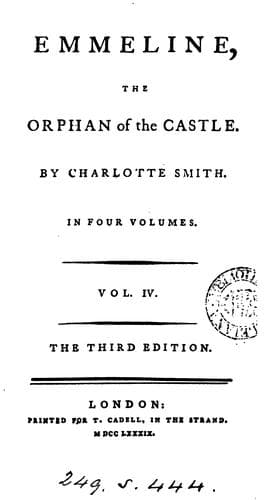
Emmeline, the Orphan of the CastleSmith, Charlotte
General
Emmeline, the Orphan of the Castle
Smith, Charlotte
Gothic fiction; Great Britain -- Social life and customs -- 18th century -- Fiction; Marriage -- Fiction; Single women -- Fiction
She could not restrain her tears. Delamere led her into the house;
where, while Mrs. Stafford gave her hartshorn and water, Delamere, at
her request, related exactly what had happened: and having given
Emmeline his honour that he would think no more of the affair if
Elkerton did not, the tranquillity of the house seemed to be restored,
and Delamere and Fitz-Edward were invited to dinner; where great
alteration in the looks of the latter, was remarked by both the ladies.
Nor was it in looks only that Fitz-Edward was extremely changed.--His
chearfulness was quite gone; he appeared to be ineffectually struggling
with some unconquerable uneasiness; and tho' his soft and insinuating
manners were the same, he no longer sought, by a thousand agreeable
sallies and lively anecdotes, to entertain; or whatever attempt he made
was so evidently forced, that it lost it's success. Remarkable for his
temperance at table, for which he had often endured the ridicule of his
companions, he now seemed to fly to the bottle, against his inclination,
as if in hopes to procure himself a temporary supply of spirits.
Every day after that on which Emmeline and Mrs. Stafford made this
remark, it's justice was more evident.
While Delamere was in the fields, Fitz-Edward would sit whole mornings
with Mrs. Stafford and Emmeline, leaning on their work-table, or looking
over Emmeline, busied with her pencil. Had his marked attention to Mrs.
Stafford continued, she would have seen his behaviour with great alarm;
but he no longer paid her those oblique yet expressive compliments of
which he used to be so lavish. It seemed, as if occupied by some other
object, he still admired and revered her, and wished to make her the
confidant of the sorrow that oppressed him. If they were accidentally
alone, he appeared on the point of telling her; then suddenly checking
himself, he changed the discourse, or abruptly left her; and as he was a
man whom it was impossible to know without receiving some impressions in
his favour, she felt, as well as Emmeline, a pity for him, which they
wished to be justified in feeling, by hearing that whatever was the
cause of his unhappiness, he had not brought it on himself by any crime
that would make their regard for him blameable.--For Emmeline, tho' she
knew that it was with no good design he had contributed to Delamere's
getting her off, yet could not persuade herself to hate him for it, when
he not only humbly solicited her forgiveness, but protested that he was
truly rejoiced, as well as astonished at her steadiness and good
conduct; and would be so far from encouraging any such attempt for the
future, that he would be the first to call Delamere to an account, could
he suppose he harboured intentions which he now considered as ungenerous
and criminal.
Public-domain text, read in full here on John Shaqi.
Reviews
Reviews
No reviews yet
Be the first to share your thoughts on this work.
Elsewhere in the archive
Join the Discussion
Join the discussion
Sign in to leave a comment or review.
Sign InorCreate an account