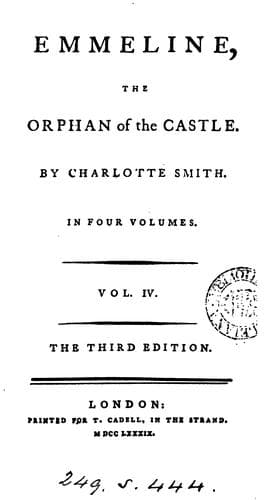
Emmeline, the Orphan of the CastleSmith, Charlotte
General
Emmeline, the Orphan of the Castle
Smith, Charlotte
Gothic fiction; Great Britain -- Social life and customs -- 18th century -- Fiction; Marriage -- Fiction; Single women -- Fiction
These declarations had made his peace both with Emmeline and her friend;
and his languid and sentimental conversation, tho' it made him less
entertaining, did not make him less interesting to either of them.
Mr. Stafford, ever in pursuit of some wild scheme, was now gone for a
few days into another county, to make himself acquainted with the
process of manuring land with old wigs--a mode of agriculture on which
Mr. Headly had lately written a treatise so convincing, that Mr.
Stafford was determined to adopt it on his own farm as soon as a
sufficient number of wigs could be procured for the purpose.
During this absence, and on the fourth day after Elkerton's exploit, a
stormy morning had driven Delamere from the fields; who went into Mrs.
Stafford's dressing-room, where he found Fitz-Edward reading Cecilia to
Mrs. Stafford and Miss Mowbray while they sat at work.
Mrs. Stafford had her two little boys at her feet; and when Delamere
appeared, she desired him to take a chair quietly, and not disturb so
sober a party. But he had not been seated five minutes, before the
children, who were extremely fond of him, crept to him, and he began to
play with them and to make such a noise, that Mrs. Stafford laughingly
threatened to send all the riotous boys into the nursery together--when
at that moment Millefleur, who had some time before come down to attend
his master, entered the room with a letter which he said came express
from Berkley-square.
Delamere saw that his father's hand had almost illegibly directed it. He
opened it in fearful haste, and read these words--
'Before this meets you, your mother will probably be no more. A
paragraph in the newspaper, in which you are said to have been
killed in a duel, threw her into convulsions. I satisfied myself of
your safety by seeing the man with whom you fought, but your mother
is incapable of hearing it. Unhappy boy! if you would see her
alive, come away instantly.
MONTREVILLE.'
_Berkley-square, Feb. 29._
It is impossible to say whether the consternation of Emmeline or that of
Delamere was the greatest. By the dreadful idea of having occasioned his
mother's death, every other was for a moment absorbed. He flew without
speaking down stairs, and into the stable where he had left his horse;
but the groom had carried the horse to his own stables, supposing his
master would stay 'till night. Without recollecting that he might take
one of Mr. Stafford's, he ran back into the room where Emmeline was
weeping in the arms of her friend, and clasping her wildly to his bosom,
he exclaimed--'Farewell, Emmeline! Farewell, perhaps, for ever! If I
lose my mother I shall never forgive _myself_; and shall be a wretch
unworthy of _you_. Dearest Mrs. Stafford! take care I beseech you of
her, whatever becomes of me.'
Public-domain text, read in full here on John Shaqi.
Reviews
Reviews
No reviews yet
Be the first to share your thoughts on this work.
Elsewhere in the archive
Join the Discussion
Join the discussion
Sign in to leave a comment or review.
Sign InorCreate an account