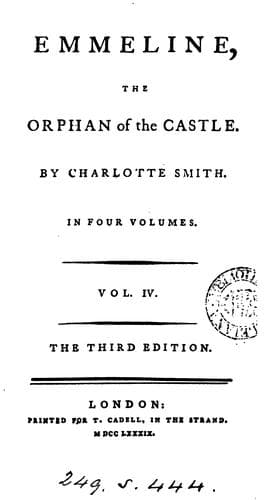
Emmeline, the Orphan of the CastleSmith, Charlotte
General
Emmeline, the Orphan of the Castle
Smith, Charlotte
Gothic fiction; Great Britain -- Social life and customs -- 18th century -- Fiction; Marriage -- Fiction; Single women -- Fiction
Having said this, he ran away again without his hat, and darted across
the lawn towards his own house, meaning to go thither on foot; but
Fitz-Edward, with more presence of mind, was directing two of Mr.
Stafford's horses to be saddled, with which he soon overtook Delamere;
and proceeding together to the town, they got into a post-chaise, and
went as expeditiously as four horses could take them, towards London.
Equally impetuous in all his feelings, his grief at the supposed
misfortune was as violent as it could have been had he been sure that
the worst had already happened. He now remembered, with infinite
self-reproach, how much uneasiness and distress he had occasioned to
Lady Montreville since he left her in November at Audley-Hall without
taking leave--and recollecting all her tenderness and affection for him
from the earliest dawn of his memory; her solicitude in his sickness,
when she had attended him herself and given up her rest and health to
contribute to his; her partial fondness, which saw merit even in his
errors; her perpetual and ardent anxiety for what she believed would
secure his happiness--he set in opposition to it his own neglect,
impatience, and disobedience; and called himself an unnatural and
ungrateful monster.
Fitz-Edward could hardly restrain his extravagant ravings during the
journey; which having performed as expeditiously as possible, they
arrived in Berkley-square; where, when the porter opened the door to
them, Delamere had not courage to ask how his mother did; but on
Fitz-Edward's enquiry, the porter told them she was alive, and not
worse.
Relieved by this account, Delamere sent to his father to know if he
might wait upon him.
His Lordship answered--"That he would only see Colonel Fitz-Edward; but
that Delamere might come in, to wait 'till his mother's physicians
arrived."
Lord Montreville was indeed so irritated against Delamere by all the
trouble and anxiety he had suffered on his account, that he determined
to shew his resentment; and in this resolution he was encouraged by Sir
Richard Crofts, who represented to him that his mother's danger, and his
father's displeasure, might together work upon his mind, and induce him
to renounce an attachment which occasioned to them both so much
unhappiness.
It was in this hope that his Lordship refused to see his son; and while
Fitz-Edward went to him, Delamere was shewn into another room, where his
youngest sister immediately came to him.
Public-domain text, read in full here on John Shaqi.
Reviews
Reviews
No reviews yet
Be the first to share your thoughts on this work.
Elsewhere in the archive
Join the Discussion
Join the discussion
Sign in to leave a comment or review.
Sign InorCreate an account