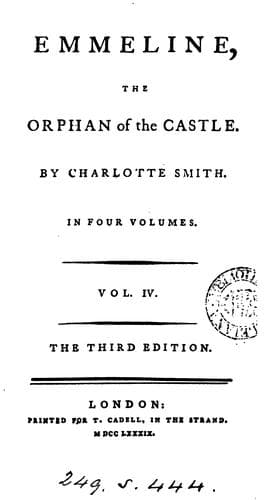
Emmeline, the Orphan of the CastleSmith, Charlotte
General
Emmeline, the Orphan of the Castle
Smith, Charlotte
Gothic fiction; Great Britain -- Social life and customs -- 18th century -- Fiction; Marriage -- Fiction; Single women -- Fiction
The elder Crofts, who had been some time with Lady Montreville and her
daughter, had named Delamere from time to time in his letters to his
brother. The last, mentioned that he was now with his mother and sister,
who were at Nice, and who purposed returning to England in about three
months. Crofts represented Delamere as still devoted to Emmeline; and as
existing only in the hope of being no longer opposed in his intention of
marrying her in March, when the year which he had promised his father to
wait expired; but that Lady Montreville, as time wore away, grew more
averse to the match, and more desirous of some event which might break
it off. Crofts gave his brother a very favourable account of his
progress with Miss Delamere; and hinted that if he could be fortunate
enough to put an end to Delamere's intended connection, it would so
greatly conciliate the favour of Lady Montreville, that he dared hope
she would no longer oppose his union with her daughter: and when once
they were married, and the prejudices of the mother to an inferior
alliance conquered, he had very little doubt of Lord Montreville's
forgiveness, and of soon regaining his countenance and friendship.
This account from his brother added another motive to those which
already influenced the malignant and illiberal mind of James Crofts to
injure the lovely orphan, and he determined to give all his assistance
to Mrs. Ashwood in the cruel project of depriving her at once of her
character and her lover. In a consultation which he held on this subject
with his promised bride and Miss Galton, the ladies agreed that it was
perfectly shocking that such a fine young man as Mr. Delamere should be
attached to a woman so little sensible of his value as Emmeline; that it
had long been evident she was to him indifferent, and it was now too
clear that she was partial to another; and that therefore it would be a
meritorious action to acquaint him of her intimacy with Fitz-Edward; and
it could not be doubted but his knowledge of it would, high spirited as
he was, cure him effectually of his ill-placed passion, and restore the
tranquillity of his respectable family. Hiding thus the inveterate envy
and malice of their hearts under this hypocritical pretence, they next
considered how to give the information which was so meritorious.
Anonymous letters were expedients to which Miss Galton had before had
recourse, and to an anonymous letter they determined to commit the
secret of Emmeline's infidelity--while James Crofts, in his letters to
his brother, was to corroborate the intelligence it contained, by
relating as mere matter of news what had actually and evidently
happened, Emmeline's sudden departure from Woodfield.
Public-domain text, read in full here on John Shaqi.
Reviews
Reviews
No reviews yet
Be the first to share your thoughts on this work.
Elsewhere in the archive
Join the Discussion
Join the discussion
Sign in to leave a comment or review.
Sign InorCreate an account