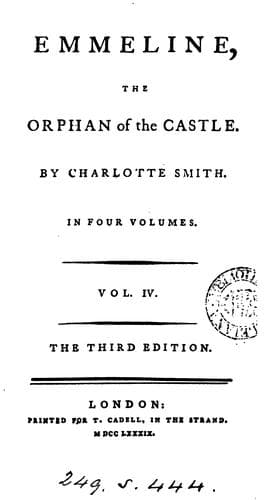
Emmeline, the Orphan of the CastleSmith, Charlotte
General
Emmeline, the Orphan of the Castle
Smith, Charlotte
Gothic fiction; Great Britain -- Social life and customs -- 18th century -- Fiction; Marriage -- Fiction; Single women -- Fiction
Delamere, when he saw his mother out of danger at Barege, had returned
to the neighbourhood of Paris, where he had lingered some time, in hopes
that Emmeline would accede to his request of being allowed to cross the
channel for a few days; but her answer, in which she strongly urged the
hazard he would incur of giving his father a pretence to withdraw _his_
promise, by violating his own, had obliged him, tho' with infinite
reluctance, to give up the scheme; and being quite indifferent where he
was, if he was still at a distance from her, he had yielded to the
solicitations of Lady Montreville, and rejoined her at Nice. There, he
now remained; while every thing in England seemed to contribute to
assist the designs of those who wished to disengage him from his passion
for Emmeline.
The day after Emmeline's departure with Lady Adelina, Fitz-Edward went
to Woodfield; and hearing that Miss Mowbray had suddenly left it, was
thrown into the utmost astonishment--astonishment which Mrs. Ashwood and
Miss Galton observed to each other was the finest piece of acting they
had ever seen.
The whole party were together when he was introduced--a circumstance
Mrs. Stafford would willingly have avoided, as it was absolutely
necessary for her to speak to him alone; and determined to do so,
whatever construction the malignity of her sister-in-law might put upon
it, she said--
'I have long promised you, Colonel, a sight of the two pieces of drawing
which Miss Mowbray and I have finished as companions. They are now
framed; and if you will come with me into my dressing-room you shall see
them.'
As the rest of the company had frequently seen these drawings, there was
no pretence for their following Mrs. Stafford; who, accompanied by the
Colonel, went to her dressing room.
A conference thus evidently sought by Mrs. Stafford, excited the eager
and painful curiosity of the party in the parlour.
'Now would I give the world,' cried Mrs. Ashwood, 'to know what is going
forward.'
'Is it not possible to listen?' enquired Crofts, equal to any meanness
that might gratify the malevolence of another or his own.
'Yes,' replied Mrs. Ashwood, 'if one could get into the closet next the
dressing-room without being perceived, which can only be done by passing
thro' the nursery. If indeed the nursery maids and children are out, it
is easy enough.'
'They are out, mama, I assure you,' cried Miss Ashwood, 'for I saw them
myself go across the lawn since I've been at breakfast. Do, pray let us
go and listen--I long of all things to know what my aunt Stafford can
have to say to that sly-looking Colonel.'
'No, no, child,' said her mother, 'I shall not send you, indeed--but
Crofts, do you think we should be able to make it out?'
'Egad,' answered he, 'I'll try--for depend upon it the mischief will
out. It will be rare, to have such a pretty tale to tell Mr. Delamere of
his demure-looking little dear.--I'll venture.'
Public-domain text, read in full here on John Shaqi.
Reviews
Reviews
No reviews yet
Be the first to share your thoughts on this work.
Elsewhere in the archive
Join the Discussion
Join the discussion
Sign in to leave a comment or review.
Sign InorCreate an account