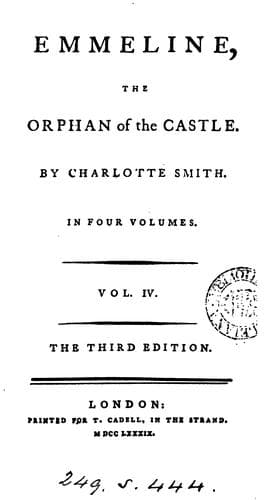
Emmeline, the Orphan of the CastleSmith, Charlotte
General
Emmeline, the Orphan of the Castle
Smith, Charlotte
Gothic fiction; Great Britain -- Social life and customs -- 18th century -- Fiction; Marriage -- Fiction; Single women -- Fiction
Godolphin then took his leave; and Emmeline, whose heart had throbbed
violently throughout this dialogue, sat down alone to compose and
recollect herself. She saw, that to keep Godolphin many days ignorant of
the truth would be impossible: and from the eager anxiety of his
questions, she feared that all the horrors Lady Adelina's troubled
imagination had represented would be realized--apprehensions, which
seemed armed with new terror since she had seen and conversed with this
William Godolphin, of whose excellent heart and noble spirit she had
before heard so much both from Lady Adelina and Fitz-Edward, and whose
appearance seemed to confirm the favourable impression those accounts
had given her.
Godolphin, who was now about five and twenty, had passed the greatest
part of his life at sea. The various climates he had visited had
deprived his complexion of much of it's English freshness; but his face
was animated by dark eyes full of intelligence and spirit; his hair,
generally carelessly dressed, was remarkably fine, and his person tall,
light, and graceful, yet so commanding, that whoever saw him immediately
and involuntarily felt their admiration mingled with respect. His whole
figure was such as brought to the mind ideas of the race of heroes from
which he was descended; his voice was particularly grateful to the ear,
and his address appeared to Emmeline to be a fortunate compound of the
insinuating softness of Fitz-Edward with the fire and vivacity of
Delamere. Of this, however, she could inadequately judge, as he was now
under such depression of spirits: and however pleasing he appeared,
Emmeline, who conceived herself absolutely engaged to Delamere, thought
of him only as the brother of Lady Adelina; yet insensibly she felt
herself more than ever interested for the event of his hearing how
little Fitz-Edward had deserved the warm friendship he had felt for him.
And her thoughts dwelling perpetually on that subject, magnified the
painful circumstances of the approaching éclaircissemen; while her fears
for Lady Adelina's life, who continued to languish in a low fever with
frequent delirium, so harrassed and oppressed her, that her own health
was visibly affected. But without attending to it, she passed all her
hours in anxiously watching the turns of Lady Adelina's disorder; or,
when she could for a moment escape, in giving vent to her full heart by
weeping over the little infant, whose birth, so similar to her own,
seemed to render it to her a more interesting and affecting object. She
lamented the evils to which it might be exposed; tho' of a sex which
would prevent it's encountering the same species of sorrow as that which
had embittered her own life. Of her friendless and desolate situation,
she was never more sensible than now. She felt herself more unhappy than
she had ever yet been; and would probably have sunk under her extreme
uneasiness, had not the arrival of Mrs. Stafford, at the end of three
Public-domain text, read in full here on John Shaqi.
Reviews
Reviews
No reviews yet
Be the first to share your thoughts on this work.
Elsewhere in the archive
Join the Discussion
Join the discussion
Sign in to leave a comment or review.
Sign InorCreate an account