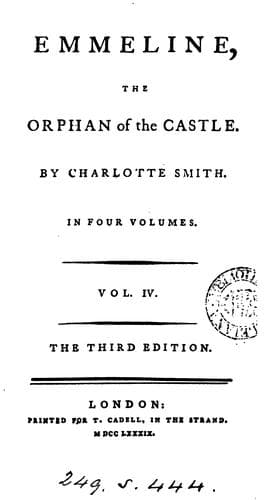
Emmeline, the Orphan of the CastleSmith, Charlotte
General
Emmeline, the Orphan of the Castle
Smith, Charlotte
Gothic fiction; Great Britain -- Social life and customs -- 18th century -- Fiction; Marriage -- Fiction; Single women -- Fiction
days, relieved her from many of her fears and apprehensions.
CHAPTER V
Mrs. Stafford no sooner heard from Emmeline that Godolphin was yet
ignorant of the true reason of Lady Adelina's concealment, than she saw
the necessity of immediately explaining it; and this task, however
painful, she without hesitation undertook.
He was therefore summoned to their lodgings by a note from Emmeline, who
on his arrival introduced him to Mrs. Stafford, and left them together;
when, with as much tenderness as possible, and mingling with the
mortifying detail many representations of the necessity there was for
his conquering his resentment, she at length concluded it; watching
anxiously the changes in Godolphin's countenance, which sometimes
expressed only pity and affection for his sister, sometimes rage and
indignation against Fitz-Edward.
Both the brothers of Lady Adelina had been accustomed to consider her
with peculiar fondness. The unfortunate circumstance of her losing her
mother immediately after her birth, seemed to have given her a
melancholy title to their tenderness; and the resemblance she bore to
that dear mother, whom they both remembered, and on whose memory their
father dwelt with undiminished regret, endeared her to them still more.
To these united claims on the heart and the protection of William
Godolphin, another was added equally forcible, in a letter written by
his father with the trembling hand of anxious solicitude, when he felt
himself dying, and when, looking back with lingering affection on the
children of her whom he hoped soon to rejoin, he saw with anguish his
youngest daughter liable from her situation to deviate into
indiscretion, and surrounded by the numberless dangers which attend on a
young and beautiful woman, whose husband has neither talents to attach
her affections or judgment to direct her actions. Lord Westhaven,
conscious of her hazardous circumstances, and feeling in his last
moments the keenest anguish, in knowing that his mistaken care had
exposed her to them, hoped, by interesting both her brothers to watch
over her, that he should obviate the dangers he apprehended. He had
therefore, in all their conversations, recommended her to his eldest
son; and as he was not happy enough to embrace the younger before he
died, had addressed to him a last letter on the same subject.
Public-domain text, read in full here on John Shaqi.
Reviews
Reviews
No reviews yet
Be the first to share your thoughts on this work.
Elsewhere in the archive
Join the Discussion
Join the discussion
Sign in to leave a comment or review.
Sign InorCreate an account