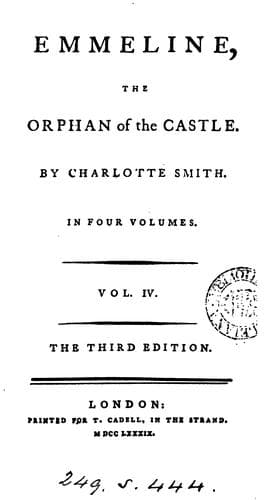
Emmeline, the Orphan of the CastleSmith, Charlotte
General
Emmeline, the Orphan of the Castle
Smith, Charlotte
Gothic fiction; Great Britain -- Social life and customs -- 18th century -- Fiction; Marriage -- Fiction; Single women -- Fiction
Delamere and Fitz-Edward soon after entered the parlour where Lord
Montreville remained. He received his son with a coldness to which, tho'
little accustomed to it, Delamere paid no attention.
Despotic as this beloved son had always been in the family, he felt not
the least apprehension that he had really offended his father; or
feeling it, knew that his displeasure would be so short liv'd that it
was not worth any concern.
'Here, Fitz-Edward,' said he--'here is my father angry with me for
making love to my cousin Emmy. Faith, Sir,' (turning to Lord
Montreville,) 'I think I have the most reason to be angry at being
brought into such dangerous company; tho' your Lordship well knows how
devilishly susceptible I am, and that ever since I was ten years old I
have been dying for some nymph or other.'
'I know that you are a strange inconsiderate boy,' answered Lord
Montreville, very gravely;--'but I must beg, Frederic, to hear no more
idle raillery on the subject of Miss Mowbray.'
To this, Delamere gave some slight answer; and the discourse was led by
his Lordship to some other topic.
Fitz-Edward, who was about five years older than Delamere, concealed,
under the appearance of candour and non-chalance, the libertinism of his
character. He had entered very young into the army; the younger son of
an Irish peer; and had contracted his loose morals by being thrown too
early into the world; for his heart was not originally bad.
With a very handsome person, he had the most insinuating manners, and an
address so truly that of a man of fashion, as immediately prejudiced in
his favour those by whom he wished to be thought well of. Where he
desired to please, he seldom failed of pleasing extremely; and his
conversation was, in the general commerce of the world, elegant and
attractive.
Delamere was very fond of his company; and Lord Montreville encouraged
the intimacy: for of whatever fashionable vices Fitz-Edward was guilty,
he contrived, by a sort of sentimental hypocrisy, to prevent their being
known to, or at least offensive to those, whose good opinion it was his
interest to cultivate.
Delamere was of a character very opposite. Accustomed from his infancy
to the most boundless indulgences, he never formed a wish, the
gratification of which he expected to be denied: and if such a
disappointment happened, he gave way to an impetuosity of disposition
that he had never been taught to restrain, and which gave an appearance
of ferocity to a temper not otherwise bad.
He was generous, candid, and humane; and possessed many other good
qualities, but the defects of his education had obscured them.
Public-domain text, read in full here on John Shaqi.
Reviews
Reviews
No reviews yet
Be the first to share your thoughts on this work.
Join the Discussion
Join the discussion
Sign in to leave a comment or review.
Sign InorCreate an account