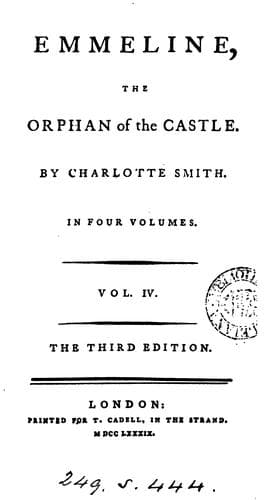
Emmeline, the Orphan of the CastleSmith, Charlotte
General
Emmeline, the Orphan of the Castle
Smith, Charlotte
Gothic fiction; Great Britain -- Social life and customs -- 18th century -- Fiction; Marriage -- Fiction; Single women -- Fiction
Lord Montreville, finding that opposition rather encreased than remedied
the violence of his son's passionate sallies, determined to try what
persuasion would do; and Delamere, whose temper was insensible to the
threats of anger, yielded to remonstrance when softened by paternal
affection; and consented to forego his intention if Lord Montreville
would tell him where Emmeline was gone.
His Lordship, who probably thought this one of those instances in which
falsehood is excuseable if not meritorious, told him, with affected
reluctance, that she was gone to board at Bridgenorth, with Mrs.
Watkins, the sister of old Carey.
As this account was extremely probable, Delamere readily believed it;
and having with some difficulty been prevailed upon to pass his word
that he would not immediately take any steps to see her, tranquillity
was for the present restored to the castle.
Emmeline in the mean time, after a long and weary journey, arrived at
Swansea. Mrs. Watkins, who expected her, received her in a little but
very neat habitation, which consisted of a small room by way of
parlour, not unlike the cabin of a packet boat, and a bed-chamber over
it of the same dimensions. Of these apartments, Emmeline took
possession. Her conductor took leave of her; and she now wished to be
able to form some opinion of her new hostess; whose countenance, which
extremely resembled that of Mrs. Carey, had immediately prejudiced her
in her favour.
Being assured by Lord Montreville of every liberal payment for the board
and lodging of Miss Mowbray, she received her with a degree of civility
almost oppressive: but Emmeline, who soon found that she possessed none
of that warmth of heart and lively interest in the happiness of others
which so much endeared to her the memory of her former friend, was very
glad when after a few days the good woman returned with her usual
avidity to the regulation of her domestic matters, and suffered Emmeline
to enjoy that solitude which she knew so well how to employ.
Delamere, still lingering at the castle, where he seemed to stay for no
other reason than because he had there seen Emmeline, was pensive,
restless, and absent; and Lord Montreville saw with great alarm that
this impression was less likely to be effaced by time and absence than
he had supposed.
Fitz-Edward, obliged to go to Ireland to his regiment for some time, had
taken leave of them; and the impatience of Lord Montreville to return to
town was encreased by repeated letters from his wife.
Delamere however still evaded it; hoping that his father would set out
without him, and that he should by that means have an opportunity of
going to Bridgenorth, where he determined to solicit Emmeline to consent
to a Scottish expedition, and persuaded himself he should not meet a
refusal.
Public-domain text, read in full here on John Shaqi.
Reviews
Reviews
No reviews yet
Be the first to share your thoughts on this work.
Join the Discussion
Join the discussion
Sign in to leave a comment or review.
Sign InorCreate an account