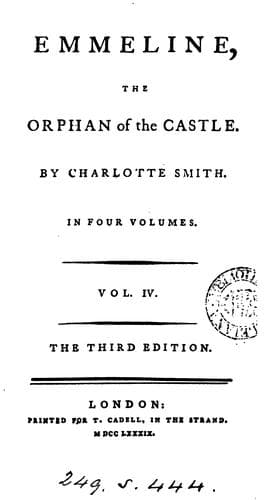
Emmeline, the Orphan of the CastleSmith, Charlotte
General
Emmeline, the Orphan of the Castle
Smith, Charlotte
Gothic fiction; Great Britain -- Social life and customs -- 18th century -- Fiction; Marriage -- Fiction; Single women -- Fiction
Immediately after the birth-day, his Lordship had quitted London on a
visit to a nobleman in Buckinghamshire, whither his son had attended
him, and where they parted. Delamere, under pretence of seeing his
friend Percival, really went into Berkshire; and Lord Montreville,
having insisted on Delamere's joining him at the house of Lady Mary
Otley, beyond Durham, where Lady Montreville and her two daughters were
already gone, set out himself for that place, where they intended to
pass the months of July and August. He had many friends to visit on the
road; and when his Lordship arrived there, he found all his letters had,
instead of following him as he had directed, been sent immediately
thither; and instead of finding his son, or an account of his intended
arrival, he had the mortification of reading Mrs. Stafford's
information.
Delamere had, indeed, passed a few days with Mr. Percival, and had
written to his father from thence; but he had also seen Headly, from
whom he had extorted the secret of Emmeline's residence.
Fitz-Edward, to whose sister Mr. Percival was lately married, had joined
Delamere at the house of his brother-in-law: and Delamere persisting in
his resolution of seeing Emmeline, had, without much difficulty,
prevailed on Fitz-Edward, (who had some weeks on his hands before he was
to join his regiment in Ireland, and who had no aversion to any plan
that looked like an intrigue) to accompany him.
They contrived to gain Mr. Percival: and Delamere, by inclosing letters
to him, which were forwarded to his father as if he had been still
there, imagined that he had prevented all probability of discovery.
Could he have persuaded Emmeline to a Scottish marriage, (which he very
firmly believed he should) he intended as soon as they were married, to
have taken her to the house of Lady Mary Otley, and to have presented
her to his father, his mother, his sisters, and Lady Mary and her
daughter, who were also his relations, as his wife.
Lord Montreville, on reading Mrs. Stafford's letter, shut himself up in
his own apartment to consider what was to be done.
He knew Delamere too well to believe that writing, or the agency of any
other person, would have on him the least effect.
He was convinced therefore he must go himself; yet to return
immediately, without giving Lady Montreville some very good reason, was
impossible; nor could he think of any that would content her, but the
truth. Though he would very willingly have concealed from her what had
happened, he was obliged to send for her, and communicate to her the
intelligence received from Mrs. Stafford.
Her Ladyship, whose pride was, if possible, more than adequate to her
high blood, and whose passions were as strong as her reason was feeble,
received this information with all those expressions of rage and
contempt which Lord Montreville had foreseen.
Public-domain text, read in full here on John Shaqi.
Reviews
Reviews
No reviews yet
Be the first to share your thoughts on this work.
Join the Discussion
Join the discussion
Sign in to leave a comment or review.
Sign InorCreate an account