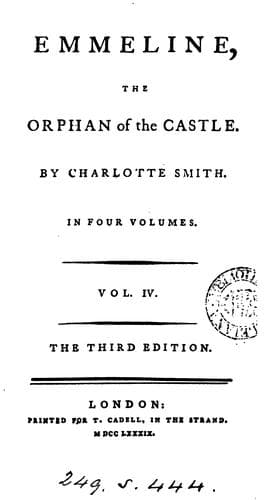
Emmeline, the Orphan of the CastleSmith, Charlotte
General
Emmeline, the Orphan of the Castle
Smith, Charlotte
Gothic fiction; Great Britain -- Social life and customs -- 18th century -- Fiction; Marriage -- Fiction; Single women -- Fiction
They dismounted, and giving their horses to their servants, joined them;
Delamere reproaching Emmeline for the artifice she had used, yet
congratulating himself on seeing her again. But his eyes eagerly running
over her person, betrayed his extreme anxiety and concern at observing
her pale and languid looks, and the lassitude of her whole frame.
Fitz-Edward, in a whisper, made the same remarks on her appearance to
Mrs. Stafford; who answered, 'that if Mr. Delamere persisted in pursuing
her, she did not doubt but that it would end in her going into a
decline.'
'Say rather,' answered Fitz-Edward artfully, 'that the interesting
languor on the charming countenance of your friend, arises from the
sensibility of her heart. She cannot surely see Delamere, dying for her
as he is, without feeling some disposition to answer a passion so ardent
and sincere: I know it is impossible she should. It is only your Stoic
prudence, your cold and unfeeling bosom, which can arm itself against
all the enthusiasm of love, all the tenderness of friendship. Miss
Mowbray's heart is made of softer materials; and were it not for the
inhuman reserve you have taught her, poor Delamere had long since met a
more suitable return to an attachment, of which, almost any other woman
would glory in being the object.'
There was something in this speech particularly displeasing to Mrs.
Stafford; who answered, 'that he could not pay her a compliment more
gratifying, than when he told her she had been the means of saving Miss
Mowbray from indiscretion; though she was well convinced, that her own
excellent understanding, and purity of heart, made any monitor
unnecessary.'
'However,' continued she, 'if you think that _my_ influence has
prevented her entering into all the wild projects of Mr. Delamere,
continue to believe, that while I am with her the same influence will
invariably be exerted to the same purpose.'
Delamere and Emmeline, who were a few paces before them while this
dialogue was passing, were now met by Parkinson, the colonel's servant,
who addressing himself to Delamere, told him that Lord Montreville and
one of the young ladies were that moment alighted from their carriage at
the inn, and had sent to his lodgings to enquire for him.
Mrs. Stafford advancing, heard the intelligence, and looked anxiously at
Emmeline, who turned paler than death at the thoughts of Lord
Montreville.
Delamere was alternately red and pale. He hesitated, and tried to
flatter himself that Parkinson was mistaken; while Fitz-Edward, who
found he should be awkwardly situated between the father and son,
silently meditated his defence.
Public-domain text, read in full here on John Shaqi.
Reviews
Reviews
No reviews yet
Be the first to share your thoughts on this work.
Join the Discussion
Join the discussion
Sign in to leave a comment or review.
Sign InorCreate an account