England -- Social life and customs -- 19th century -- Fiction
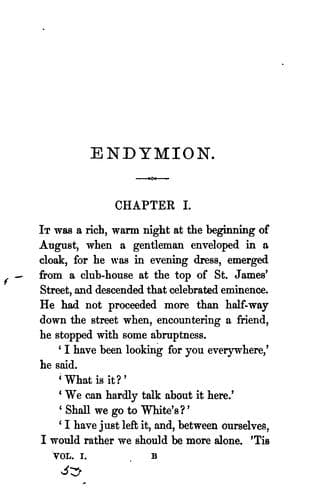
“You never used to have any, Sidney. What extraordinary revelations can
have been made to you during three months of office under a semi-Whig
Ministry?”
“Your taunt is fair, though it pains me. And I confess to you that
when I resolved to follow Canning and join his new allies, I had many a
twinge. I was bred in the Tory camp; the Tories put me in Parliament
and gave me office; I lived with them and liked them; we dined and
voted together, and together pasquinaded our opponents. And yet, after
Castlereagh’s death, to whom like yourself I was much attached, I had
great misgivings as to the position of our party, and the future of the
country. I tried to drive them from my mind, and at last took refuge in
Canning, who seemed just the man appointed for an age of transition.”
“But a transition to what?”
“Well, his foreign policy was Liberal.”
“The same as the Duke’s; the same as poor dear Castlereagh’s. Nothing
more unjust than the affected belief that there was any difference
between them--a ruse of the Whigs to foster discord in our ranks. And
as for domestic affairs, no one is stouter against Parliamentary Reform,
while he is for the Church and no surrender, though he may make a
harmless speech now and then, as many of us do, in favour of the
Catholic claims.”
“Well, we will not now pursue this old controversy, my dear Ferrars,
particularly if it be true, as you say, that Mr. Canning now lies upon
his deathbed.”
“If! I tell you at this very moment it may be all over.”
“I am shaken to my very centre.”
“It is doubtless a great blow to you,” rejoined Mr. Ferrars, “and I wish
to alleviate it. That is why I was looking for you. The King will,
of course, send for the Duke, but I can tell you there will be a
disposition to draw back our friends that left us, at least the younger
ones of promise. If you are awake, there is no reason why you should not
retain your office.”
“I am not so sure the King will send for the Duke.”
“It is certain.”
“Well,” said his companion musingly, “it may be fancy, but I cannot
resist the feeling that this country, and the world generally, are on
the eve of a great change--and I do not think the Duke is the man for
the epoch.”
“I see no reason why there should be any great change; certainly not in
this country,” said Mr. Ferrars. “Here we have changed everything that
was required. Peel has settled the criminal law, and Huskisson the
currency, and though I am prepared myself still further to reduce the
duties on foreign imports, no one can deny that on this subject the
Government is in advance of public opinion.”
“The whole affair rests on too contracted a basis,” said his companion.
“We are habituated to its exclusiveness, and, no doubt, custom in
England is a power; but let some event suddenly occur which makes a
nation feel or think, and the whole thing might vanish like a dream.”
Public-domain text, read in full here on John Shaqi.
Reviews
Reviews
No reviews yet
Be the first to share your thoughts on this work.
Join the Discussion
Join the discussion
Sign in to leave a comment or review.
Sign InorCreate an account