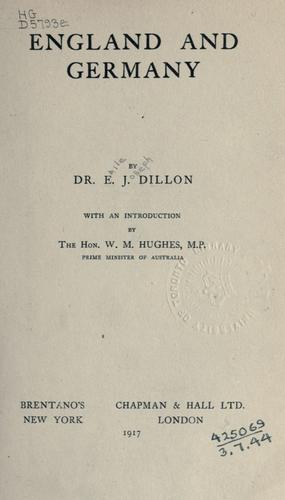
Germany -- Foreign relations; World War, 1914-1918; World War, 1914-1918 -- Economic aspects
Consider the difference between that arrangement and the attractions
provided by the Entente. Russia, France and Britain could deal only in
counters, not in hard cash like their adversaries. The utmost they
were able to offer was an undertaking to use their good offices with
Serbia and Greece to obtain the promise of a part of Bulgaria's
demands. And the fulfilment of this promise would of necessity be
conditional on the victory of the Allies. As for the weakening of
Serbia, it could not be entertained. On the contrary, that State,
according to the Entente scheme, would be greatly enlarged, would, in
fact, become by far the greatest of the Balkan nations. And for this
shadowy lure, Bulgaria was expected to meet in deadly encounter the
greatest military empires the world has ever seen, and to meet them
without the help of any of the Great Powers of the Entente.
One has but to compare these two alternatives in order to realize
that, even if Ferdinand had entered into no binding compact with
Austria and Germany, he would not hesitate a moment between them.
Personally and politically he was held tight by the Teuton tentacles.
The currency of the notion that with these competing offers before
him, a crafty statesman like Ferdinand who felt over and above that
Russia's vengeance was hanging over his head, would take what he
believed was the losing side, shows a degree of _naivete_ which cannot
be qualified without epithets which it had better be understood than
expressed.
Looking back upon the results of the first twenty months of the war
and upon the more obvious causes to which they may fairly be
ascribed, one is struck less forcibly by the military and economic
unpreparedness of the Allies for the inevitable conflict than by their
inaccessibility to the ground ideas on which Germany set her hopes of
success. The two groups of belligerents stood intellectually on
different planes. The Teuton's faith was implicit in the law of
causality, in the necessity of contemplating the vast problem as a
whole, of adjusting means to ends, of co-operation at home and
co-ordination of means abroad. The methods of the Allies were drawn
from a limited range of experience which was no longer applicable to
the new conditions, and their hopes rested on a series of isolated
exertions put forth temporarily under stress of exceptional pressure.
Public-domain text, read in full here on John Shaqi.
Reviews
Reviews
No reviews yet
Be the first to share your thoughts on this work.
Elsewhere in the archive
Join the Discussion
Join the discussion
Sign in to leave a comment or review.
Sign InorCreate an account