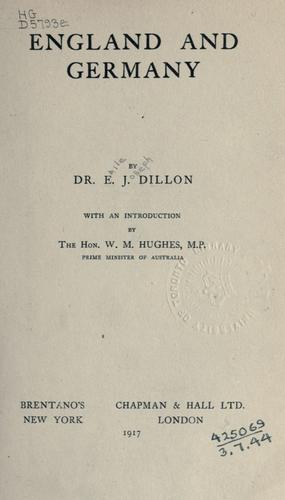
Germany -- Foreign relations; World War, 1914-1918; World War, 1914-1918 -- Economic aspects
They made noble sacrifices for the cause of liberty and justice.
Pacific by temperament and conviction, they resignedly accepted
military discipline as a temporary expedient, a purgatorial ordeal,
and went about the while with a sense of displacement, the longing of
exiles to get back. Spurred by stress of circumstance, they achieved
more than foresight and insight had led them to design but far less
than their optimism had encouraged them to anticipate. Step by step
they were driven by hard reality to widen their angle of vision, to
extend their schemes, and to concert certain measures in common. The
meeting of the three Finance Ministers in Paris was followed by the
Councils of the allied generals, by the combined expedition to the
Dardanelles, and by the nationalization of the manufacture of
munitions in each of the allied countries. And all these innovations
were moves in the right direction. But they were made as temporary
expedients under pressure of outward events, and it is still to the
future that one looks for tokens of statesmanlike intuition which from
a comprehensive survey of the problem in its entirety will draw the
materials wherewith to weave a coherent scheme of general action and
permanent co-operation.
Events travelled fast in the month of July 1915, and their effect on
the Allies was depressing. In Russia the Austro-Germans were advancing
steadily against Riga and Warsaw, where a battle which experts
accounted the most sanguinary and momentous in the war was approaching
a decision. A fatal bar being placed by Russia's reverses and other
untoward occurrences to the realization of the hopes that had been
raised by Kitchener's army, the French, headed by M. Pichon and backed
by the Russian Press, once more mooted the vexed question of Japanese
intervention. In the Turkish dominions the Greeks were subjected to
relentless persecution, especially on the coast of Asia Minor. The
massacre of Armenians on an unprecedented scale was reported from
Bitlis, Moosh, Diarbekir and Zeitun. In the first-named region 9,000
bodies, mostly women and children, were, it is alleged, cast into the
river Tigris.[105] The Swedish Premier, by an enigmatic speech in
which the doctrine of neutrality at all costs was ostentatiously
repudiated, aroused suspicion of an intention on the part of his
Government to join the Teutons in order to weaken the Slav neighbour,
and to this apprehension colour was imparted by the tardy announcement
that since the outbreak of the war Sweden had increased her army from
360,000 to 500,000 men. In the United States mysterious "accidents"
and mishaps occurred on board warships and in munitions and arms
manufactories, and strikes were organized by Germans and Austrians on
a scale which attracted the serious attention of the Washington
Government.
[105] _Novoye Vremya_, July 22, 1915.
Public-domain text, read in full here on John Shaqi.
Reviews
Reviews
No reviews yet
Be the first to share your thoughts on this work.
Elsewhere in the archive
Join the Discussion
Join the discussion
Sign in to leave a comment or review.
Sign InorCreate an account