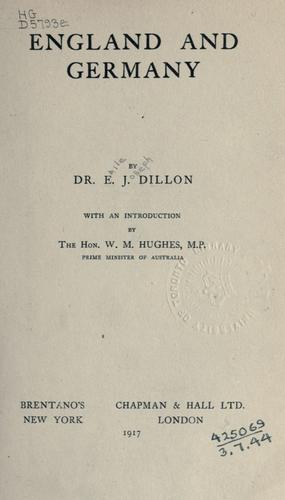
Germany -- Foreign relations; World War, 1914-1918; World War, 1914-1918 -- Economic aspects
In truth the root of the matter lies deeper. One of the most telling
factors, in every armed conflict between peoples, consists of the sum
total of imponderabilia which elude analysis. Intellectual and moral
equipment, as I ventured to write when the war began, sometimes
counts for more than battalions. And I instanced the Russo-Japanese
campaign as a case in point. One belligerent may regard the campaign
as a temporary calamity to be endured until it can be conveniently got
rid of, while another may gird his loins and go forth to battle
exultant like the fanaticized warriors of Cromwell. The former will
contemplate the struggle and regulate the conduct of it in the light
of immediate expediency, while the latter will treat the war as a
life-task and boldly throw the weight of everything he has, and is,
and hopes for into the blows he deals his adversary. Now in this
struggle the Teuton is the fanaticized warrior. He is fighting for an
ideal, which, whether or no he understands it, he caresses and deems
his very own. The hopes and dreams of the leaders of the nation have
been communicated to the individual citizen, who, having lived for
them, is ready to die for them. Our people, on the other hand, have
never enjoyed that education in patriotism which is bestowed on every
Teuton, and they are wanting in the strength of imagination, the
spirit of cohesion and the energizing social faith which might have
made up for the deficiency.
Then, again, over against the Allies' inexhaustible resources we must
put the marvellous capacity for organization which intensifies those
of our enemy. The nearest known approach to it is found in the
Japanese, who, there is little doubt, if pressed by circumstance,
would match the Teuton in resourcefulness and even outdo him in the
spirit of self-sacrifice. To this precious asset in Germany's leaders
corresponds a superlative degree of docility and self-surrender in her
people which offer a striking contrast to the strongly marked
individualist tendencies of the British, French and Russian races.
Nay, one may go farther and assert that the central streams of
national life in each of these countries flows in channels of party
politics, which no influential leader has ever attempted to deepen or
widen. The German, on the contrary, as we saw, associates his every
work and undertaking with ideas of almost cosmic breadth and is
actuated by interests to which all the larger problems of humanity are
akin. And he took timely possession of every lever that might
contribute to the success of his revolt against Europeanism, when his
far-reaching scheme was yet in the early phases of execution.
Public-domain text, read in full here on John Shaqi.
Reviews
Reviews
No reviews yet
Be the first to share your thoughts on this work.
Elsewhere in the archive
Join the Discussion
Join the discussion
Sign in to leave a comment or review.
Sign InorCreate an account