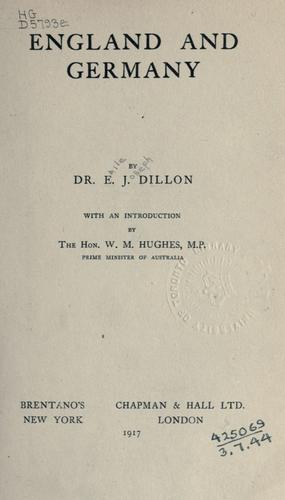
Germany -- Foreign relations; World War, 1914-1918; World War, 1914-1918 -- Economic aspects
It is still open to us to utilize our superior resources, realize our
latent strength, and ward off the dangers that beset us. But the first
advance towards the goal must be to face the facts, behold things and
persons as they are, and apply our new-found knowledge to the work of
self-rescue. Our conception of the nature of the contest in which we
are engaged must be recast. Our demands on our national leaders--not
those now in power who only mislead--must be greatly enlarged. Truth,
however bitter, must take the place of fancy. Ideas and institutions
incongruous with the new social and political conditions must be
displaced. The nation's aims and policy should be stated boldly and
clearly, and adequate machinery set up to achieve them. In a word,
system will have to be substituted for confusion, method for
haphazard. Destitute of a great or strong man, it behoves us to
imitate our enemy and create a vast organization with branches all
over the empire. But the influence of the government ever since the
outbreak of the war has militated against all those reforms.
If these changes had been effected at the outset the story of the
present campaign would have been different from what it is. A group of
belligerents representing only 5,921,000 square kilometres of
territory and 150,199,000 inhabitants, or, say, 4 per cent. of dry
land and 9.1 per cent. of human beings, would not have held its own
for twenty-one months against a group disposing of 68,031,000 square
kilometres of territory and a population of 770,060,000, or 46 per
cent. of the land on the globe and 47 per cent. of the human race.
Providence has bestowed upon the Allies the wherewithal to attain
their legitimate ends. The Allies' leaders are frittering them away.
For the thirty years of preparation do not afford us an adequate
explanation of the Teuton superiority. The clue is to be found in the
psychological factor. Germany is wholly alive, physically,
intellectually and psychically. And she lives in the present and
future. We either drowse or vegetate in and for the past. She has the
decisive advantage of possessing organization and organizers. Therein
lies the secret of her sustained success. The Allies lack both, and
are hardly conscious of the necessity of making good the deficiency.
Therein lies their weakness. It has made itself felt throughout the
campaign and will determine the upshot of the war. And in the
politico-economic struggle that will follow the war, it is the same
psychological factor which the Allies rate so low that will decide the
final issue.
Public-domain text, read in full here on John Shaqi.
Reviews
Reviews
No reviews yet
Be the first to share your thoughts on this work.
Elsewhere in the archive
Join the Discussion
Join the discussion
Sign in to leave a comment or review.
Sign InorCreate an account