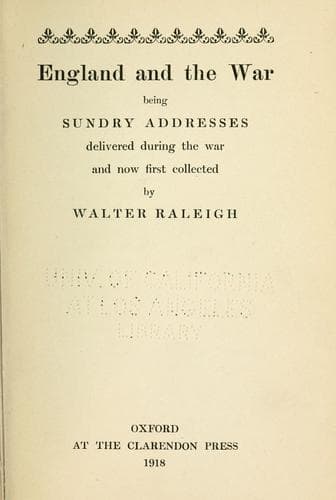
It is not a war of race. For all our differences with the Germans, any
cool and impartial mind must admit that we have many points of kinship
with them. During the years before the war our naval officers in the
Mediterranean found, I believe, that it was easier to associate on terms
of social friendship with the Austrians than with the officers of any
other foreign navy. We have a passionate admiration for France, and a
real devotion to her, but that is a love affair, not a family tie. We
begin to be experienced in love affairs, for Ireland steadily refuses to
be treated on any other footing. In any case, we are much closer to the
Germans than they are to the Bulgarians or the Turks. Of these three we
like the Turks the best, because they are chivalrous and generous
enemies, which the Germans are not.
It is a war of ideas. We are fighting an armed doctrine. Yet Burke's use
of those words to describe the military power of Revolutionary France
should warn us against fallacious attempts to simplify the issue. When
ideas become motives and are filtered into practice, they lose their
clearness of outline and are often hard to recognize. They leaven the
lump, but the lump is still human clay, with its passions and
prejudices, its pride and its hate. I remember seeing in a provincial
paper, in the early days of the war, two adjacent columns, both dealing
with the war. The first was headed 'A Holy War' and set forth the great
principles of nationality, respect for treaties, and protection of the
weak, which in our opinion are the main motives of the Allies in this
war. The second was headed 'The War on Commerce; Tips to capture German
trade', and set forth those other principles and motives which, in the
opinion of the Germans, brought England into this war.
I am not going to defend England against the charge that she entered
this war on a cold calculation of mercantile profit. Every one here
knows that the charge is utterly untrue. Those who believe the charge
could not be shaken in their belief except by being educated all over
again, and introduced to some knowledge of human nature. It is enough to
remark that this charge is a commonplace between belligerent nations.
They all like to believe that their adversaries entertain only base
motives, while they themselves act only on the loftiest ideal
promptings. If the charge means only that every nation at war is bound
to think of its own interests, to conserve its own strength, and to
seize on all material gains that are within its reach, the charge is
true and harmless. When two angry women quarrel in a back street, they
commonly accuse each other of being amorous. They might just as well
accuse each other of being human. The charge is true and insignificant.
So also with nations; they all cherish themselves and seek to preserve
their means of livelihood.
Public-domain text, read in full here on John Shaqi.
Reviews
Reviews
No reviews yet
Be the first to share your thoughts on this work.
Join the Discussion
Join the discussion
Sign in to leave a comment or review.
Sign InorCreate an account