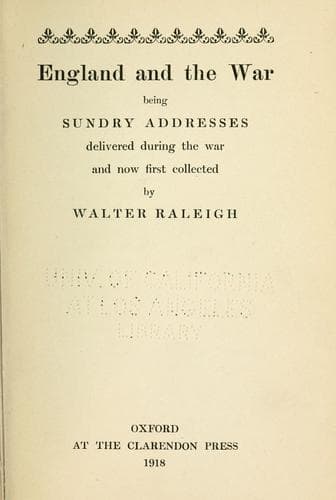
Mankind lives by ideas; and if an irreconcilable difference in ideas
makes a good war, then this is a good war. The contrast between the two
ideas is profound and far-reaching. My business lies in a University.
For a good many years before the war certain selected German students,
who had had a University education in their own country, came as Rhodes
scholars to Oxford. The intention of Mr. Rhodes was benevolent; he
thought that if German students were to reside for four years at Oxford
and to associate there, at an impressionable time of life, with young
Englishmen, understanding and fellowship would be encouraged between the
two peoples. But the German government took care to defeat Mr. Rhodes's
intention. Instead of sending a small number of students for the full
period, as Mr. Rhodes had provided, Germany asked and (by whose mistake
I do not know) obtained leave to send a larger number for a shorter
stay. The students selected were intended for the political and
diplomatic service, and were older than the usual run of Oxford
freshmen. Their behaviour had a certain ambassadorial flavour about it.
They did not mix much in the many undergraduate societies which flourish
in a college, but met together in clubs of their own to drink patriotic
toasts. They were nothing if not superior. I remember a conversation I
had with one of them who came to consult me. He wished, he said, to do
some definite piece of research work in English literature. I asked him
what problems or questions in English literature most interested him,
and he replied that he would do anything that I advised. We had a talk
of some length, wholly at cross-purposes. At last I tried to make my
point of view clear by reminding him that research means finding the
answer to a question, and that if his reading of English literature,
which had been fairly extensive, had suggested no questions to his mind,
he was not in the happiest possible position to begin research. This
touched his national pride, and he gave me something not unlike a
lecture. In Germany, he said, the professor tells you what you are to
do; he gives you a subject for investigation, he names the books you are
to read, and advises you on what you are to write; you follow his
advice, and produce a thesis, which gains you the degree of Doctor of
Letters. I have seen a good many of these theses, and I am sure this
account is correct. With very rare exceptions they are as dead as
mutton, and much less nourishing. The upshot of our conversation was
that he thought me an incompetent professor, and I thought him an
unprofitable student.
Public-domain text, read in full here on John Shaqi.
Reviews
Reviews
No reviews yet
Be the first to share your thoughts on this work.
Join the Discussion
Join the discussion
Sign in to leave a comment or review.
Sign InorCreate an account