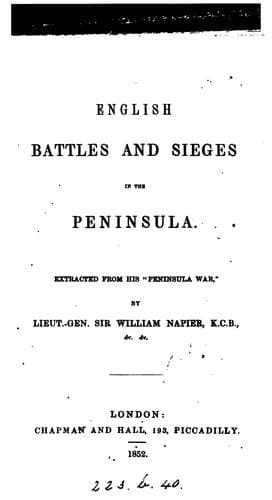
English Battles and Sieges in the Peninsula.: Extracted from his 'Peninsula War'.Napier, William Francis Patrick
History
English Battles and Sieges in the Peninsula.: Extracted from his 'Peninsula War'.
Napier, William Francis Patrick
Peninsular War, 1807-1814
He still hoped the French would give battle at the Arapiles, but
placed the first division at Aldea Tejada on the Junguen stream, to
secure a passage in case Soult should finally compel him to choose
between Salamanca and Rodrigo. Meantime Clausel’s army, now under
Drouet, finding the bridge of Alba broken and the castle occupied, also
crossed the Tormes at Galisancho, and then Soult, who had commenced
fortifying Mozarbes, extended his left towards the Rodrigo road: yet
slowly, because the ground was heavy and crossed by the many sources
of the Junguen and Valmusa streams, which were flooded with the rain.
This movement was like that of Marmont at the battle of Salamanca,
but on a wider circle, and an outward range of heights, beyond a
sudden attack and catastrophe. The result in each case was remarkable.
Marmont closing with a short quick turn, a falcon striking at an eagle,
received a buffet that broke his pinions and spoiled his flight. Soult,
a wary kite, sailing slowly and with a wide wheel to seize his prey,
lost it altogether.
When Wellington saw the French cavalry pointing to the Rodrigo
road, he judged the design was first to establish a fortified head
of cantonments at Mozarbes, from whence to operate against the
communication with Rodrigo; wherefore suddenly casting his army into
three columns he crossed the Junguen, and covering his left flank with
cavalry and guns, defiled in order of battle with a wonderful boldness
and facility at little more than cannon-shot from his enemy. He had
good fortune however to aid: for there was a thick fog and a heavy rain
which rendered the bye-ways and fields nearly impassable to the French
while he used the high roads. Then he took his army in one mass quite
round the French left, and having gained the Valmusa river halted for
the night, in rear of those who had been threatening him in front only
a few hours before!
This was truly a surprising exploit, yet it was not creditable to the
generalship on either side. The English commander, having suffered
Soult to pass the Tormes and turn his position, waited too long on the
Arapiles, or this dangerous movement would have been unnecessary; and
a combination of bad roads, bad weather, and want of vigour on the
other side, rendered it possible and no more. It has been said by a
great master, that the defect of Soult’s military genius was a want of
promptness to strike at the decisive moment, and here he was certainly
slack.
Public-domain text, read in full here on John Shaqi.
Reviews
Reviews
No reviews yet
Be the first to share your thoughts on this work.
Elsewhere in the archive
Join the Discussion
Join the discussion
Sign in to leave a comment or review.
Sign InorCreate an account