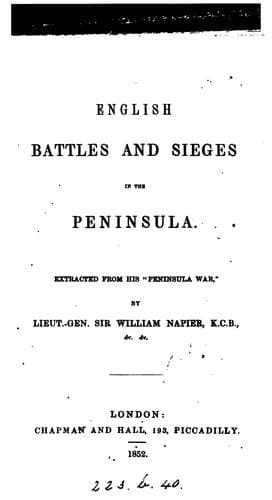
English Battles and Sieges in the Peninsula.: Extracted from his 'Peninsula War'.Napier, William Francis Patrick
History
English Battles and Sieges in the Peninsula.: Extracted from his 'Peninsula War'.
Napier, William Francis Patrick
Peninsular War, 1807-1814
On the 16th the allies retired by three roads, all of which led, by
Tamames, San Munos, and Martin del Rio, to Rodrigo, through a forest
penetrable in all directions: in the evening they halted behind the
Matilla river. This march was only of twelve miles, yet stragglers
were numerous, and the soldiers finding vast herds of swine quitted
their colours by hundreds to shoot them; indeed such a rolling musketry
echoed through the forest, that Wellington thought the enemy was upon
him. Every effort was made to stop this excess, and two offenders were
hanged; still the hungry men broke from the columns, the property of
whole districts was swept away in a few hours, and the army was in
some degree placed at the mercy of the enemy; who were however content
to glean the stragglers, of whom they captured two thousand: they did
not press the rear until evening, when their lancers fell on, but were
checked by the 28th Regiment and the Light Dragoons.
During the night, the light division having the rear-guard, the cavalry
in the front, for some unknown reason, filed off by the flanks without
giving any intimation of the movement, and at daybreak as the soldiers
of the division were rolling their blankets some strange horsemen
were seen behind the bivouac; they were taken for Spaniards, until
their cautious movements and vivacity of gesture showed them to be
French. The troops run to arms, in good time, for five hundred yards
in front the wood opened on a large plain, where eight thousand French
horsemen were discovered advancing in one solid mass, yet carelessly,
and without suspecting the vicinity of the British. The division
immediately formed columns, two squadrons of dragoons came hastily
up from the rear, and Julian Sanchez’ cavalry also appeared in small
parties on the right flank. This checked the enemy’s march while the
infantry retired, but the French, though fearing to close, sent many
squadrons to the right and left, some of which rode on the flanks near
enough to bandy wit in the Spanish tongue with the British soldiers,
and very soon mischief was visible: the road was strewed with baggage,
the bâtmen came running in for protection, some wounded, some without
arms, and all breathless as just escaped from a surprise.
Public-domain text, read in full here on John Shaqi.
Reviews
Reviews
No reviews yet
Be the first to share your thoughts on this work.
Elsewhere in the archive
Join the Discussion
Join the discussion
Sign in to leave a comment or review.
Sign InorCreate an account