If he borrowed, however, he borrowed from his
English predecessors, and he brought to his task an individuality and an
artistic instinct which cannot be denied.
After Payne and Lewis, English binding, like French, became purely
imitative in its designs; but while in our own decade the French artists
have endeavoured to shake themselves free from old traditions by mere
eccentricity, in England we have several living binders, such as Mr.
Cobden Sanderson and Mr. Douglas Cockerell, who work with notable
originality and yet with the strictest observance of the canons of their
art.
Moreover in the application of decorative designs to cloth cases England
has invented, and England and America have brought to perfection, an
inexpensive and very pleasing form of book-cover, which gives the
bookman ample time to consider whether his purchase is worth the more
permanent honours of gilded leather, and also, by the facts that it is
avowedly temporary, and that its decoration is cheaply and easily
effected by large stamps, renders forgivable vagaries of design, which
when translated, as they have been of late years in France, into the
time-honoured and solemn leather, seem merely incongruous and
irreverent.
In binding, then, as in the other bookish arts, the part which English
workers have played has been no insignificant or unworthy one, and the
development of this art, as of the others, in our own country is worthy
of study. In this case much has already been done, for the illustrations
of _English Bookbindings at the British Museum_, edited, with
introduction and descriptions by Mr. W. Y. Fletcher, present the student
with the best possible survey of the whole subject, while the excellent
treatises of Miss Prideaux and Mr. Horne bring English bookbinding into
relation with that of other countries. Here, then, there is no need of a
new general history, but rather of special monographs, treating more in
detail of the periods at which our English binders have done the best
work. The old stamped bindings of the days of manuscript, the
embroidered bindings of the sixteenth and seventeenth centuries, the
leather bindings of Mearne and his fellows under the later Stuarts, and
the work of Roger Payne--all these seem to offer excellent subjects for
unpretentious monographs, and it is hoped that others of them besides
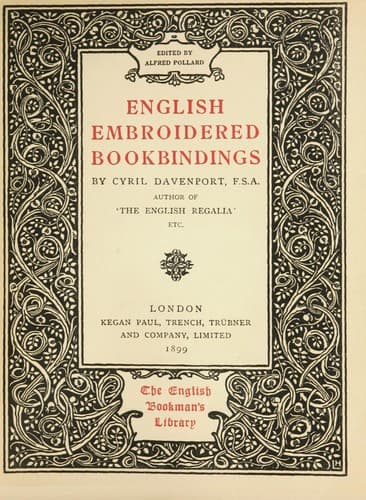
the _English Embroidered Bindings_, with which Mr. Davenport has made a
beginning, may be treated in this series.
Public-domain text, read in full here on John Shaqi.
Reviews
Reviews
No reviews yet
Be the first to share your thoughts on this work.
Join the Discussion
Join the discussion
Sign in to leave a comment or review.
Sign InorCreate an account