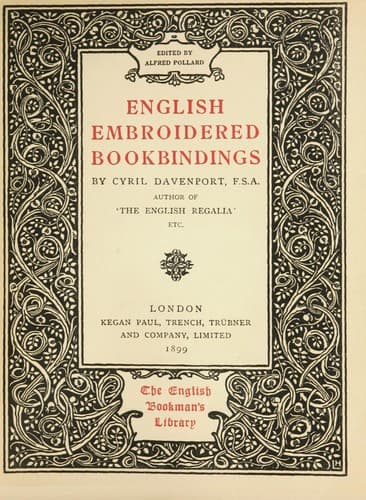
I have purposely left to the last the subject of Bindings, as this,
being more immediately cognate to Mr. Davenport's book, may fairly be
treated at rather greater length. If the French dictum 'la reliure est
un art tout francais' is not without its historical justification, it is
at least possible to show that England has done much admirable work, and
that now and again, as in the other bookish arts, she has attained
preeminence.
The first point which may fairly be made is that England is the only
country besides France in which the art has been consistently practised.
In Italy, binding, like printing, flourished for a little over half a
century with extraordinary vigour and grace, and then fell suddenly and
completely from its high estate. From 1465 to the death of Aldus the
books printed in Italy were the finest in the world; from the beginning
of the work of Aldus to about 1560 Italian bindings possess a freedom of
graceful design which even the superior technical skill quickly gained
by the French does not altogether outbalance. But just as after about
1520 a finely printed Italian book can hardly be met with, so after
1560, save for a brief period during which certain fan-shaped designs
attained prettiness, there have been no good Italian bindings. In
Germany, when in the fifteenth century, before the introduction of gold
tooling, there was a thriving school of binders working in the mediaeval
manner, the Renaissance brought with it an absolute decline. Holland,
again, which in the fifteenth century had made a charming use of large
panel stamps, has since that period had only two binders of any
reputation, Magnus and Poncyn, of Amsterdam, who worked for the
Elzeviers and Louis XIV. Of Spanish bindings few fine specimens
have been unearthed, and these are all early. Only England can boast
that, like France, she has possessed one school of binders after
another, working with varying success from the earliest times down to
the present century, in which bookbinding all over Europe has suffered
from the servility with which the old designs, now for the first time
fully appreciated, have been copied and imitated.
Public-domain text, read in full here on John Shaqi.
Reviews
Reviews
No reviews yet
Be the first to share your thoughts on this work.
Join the Discussion
Join the discussion
Sign in to leave a comment or review.
Sign InorCreate an account