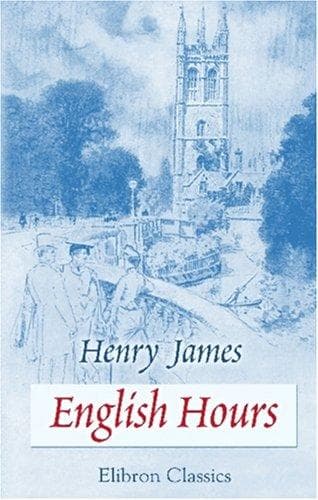
England -- Description and travel; James, Henry, 1843-1916 -- Travel -- England
I daresay I speak of “Denis Duval” as “old” mainly to make an
impression on readers whose age is less. I remember, after all,
perfectly, the poetry of its original appearance—there was such a
thrill, in those days, even after “Lovel the Widower” and “Philip,” at
any new Thackeray—in the cherished “Cornhill” of the early time, with
a drawing of Frederick Walker to its every number and a possibility
of its being like “Esmond” in its embroidered breast. If, moreover,
it after a few months broke short off, that really gave it something
as well as took something away. It might have been as true of works
of art as of men and women, that if the gods loved them they died
young. “Denis Duval” was at any rate beautiful, and was beautiful
again on reperusal at a later time. It is all beautiful once more
to a final reading, only it is remarkably different: and this is
precisely where my story lies. The beauty is particularly the beauty
of its being its author’s—which is very much, with book after book,
what we find ourselves coming to in general, I think, at fifty years.
Our appreciation changes—how in the world, with experience always
battering away, shouldn’t it?—but our feeling, more happily, doesn’t.
There _are_ books, of course, that criticism, when we are fit for it,
only consecrates, and then, with association fiddling for the dance,
we are in possession of a literary pleasure that is the highest of
raptures. But in many a case we drag along a fond indifference, an
element of condonation, which is by no means of necessity without its
strain of esteem, but which, obviously, is not founded on one of our
deeper satisfactions. Each can but speak, at all events, on such a
matter, for himself. It is a matter also, doubtless, that belongs to
the age of the loss—so far as they quite depart—of illusions at large.
The reason for liking a particular book becomes thus a better, or at
least a more generous, one than the particular book seems in a position
itself at last to supply. Woe to the mere official critic, the critic
who has never felt the _man_. You go on liking “The Antiquary” because
it is Scott. You go on liking “David Copperfield”—I don’t say you go on
reading it, which is a very different matter—because it is Dickens. So
you go on liking “Denis Duval” because it is Thackeray—which, in this
last case, is the logic of the charm I alluded to.
[Illustration: RYE, FROM WINCHELSEA GATE]
Public-domain text, read in full here on John Shaqi.
Reviews
Reviews
No reviews yet
Be the first to share your thoughts on this work.
Elsewhere in the archive
Join the Discussion
Join the discussion
Sign in to leave a comment or review.
Sign InorCreate an account